tag > Science
-
The Book of Change
On time, and the place where every attempt to explain it runs out.
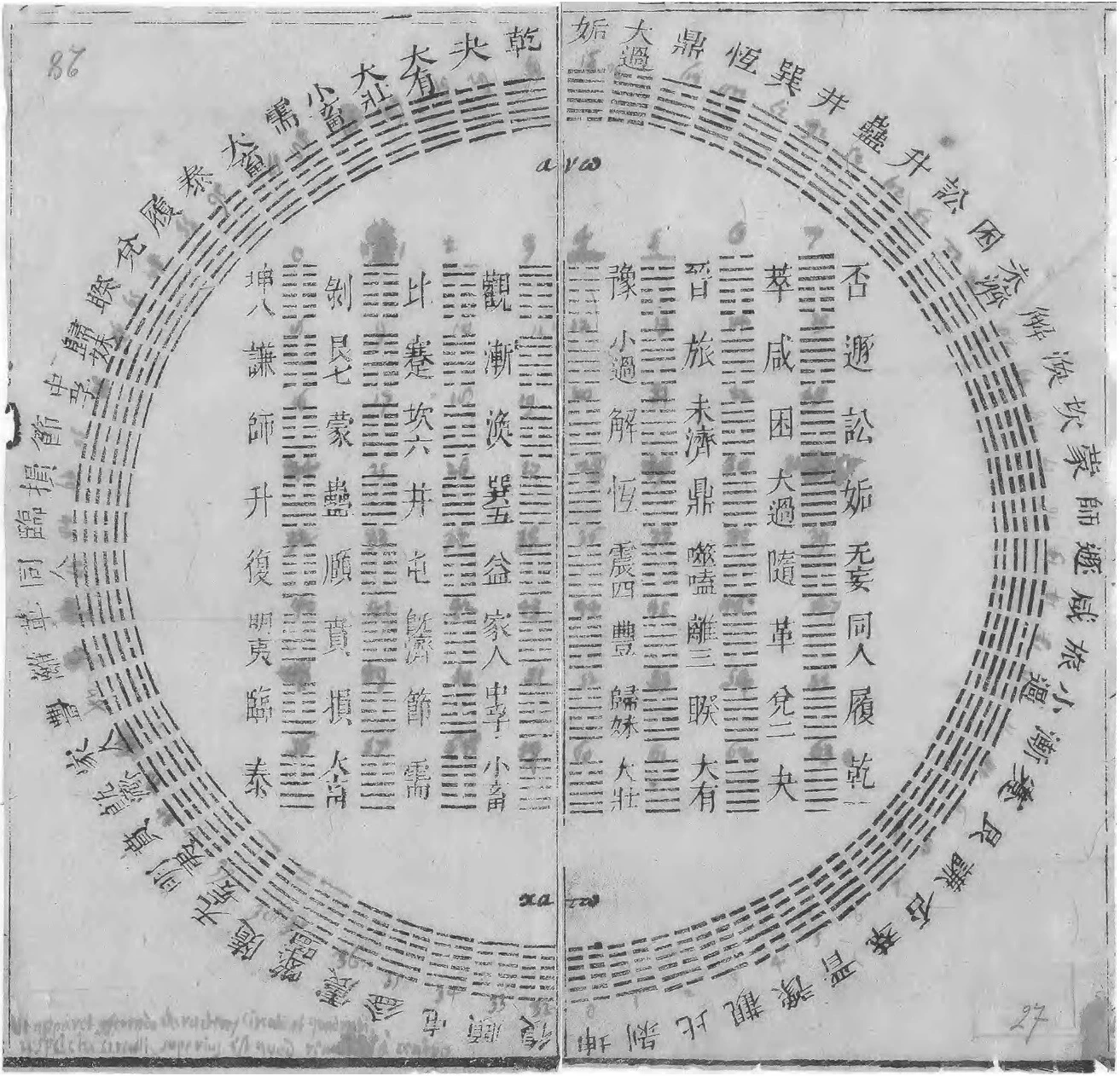
Shao Yong’s arrangement of the 64 hexagrams, sent to Leibniz from Beijing by Joachim Bouvet in 1701. Read broken lines as 0 and unbroken lines as 1, and the square counts from 0 to 63 in binary. Public domain. A cup of tea cools and never warms itself again. A footprint in wet sand holds its shape for a while, then fills in. Energy, information and life all depend on this one fact: the world runs one way. Without that asymmetry nothing could be stored, learned or used. So what is time? This essay follows the question until it runs out. It runs out in the same place every time, and the oldest book about change seems to have begun there.
Part oneWhat physics knows
Start with what is solid. In 1908 Hermann Minkowski told a meeting of scientists: “Henceforth space by itself, and time by itself, are doomed to fade away into mere shadows, and only a kind of union of the two will preserve an independent reality.” Relativity made the two a single fabric, spacetime, and how you cut it into space and time depends on how you are moving. This is not abstract. A clock on a GPS satellite gains about 38 microseconds a day on a clock on the ground, because of the satellite’s speed and its height. A blink lasts thousands of times longer. Still, the system has to correct for it, or positions would drift by kilometres a day.
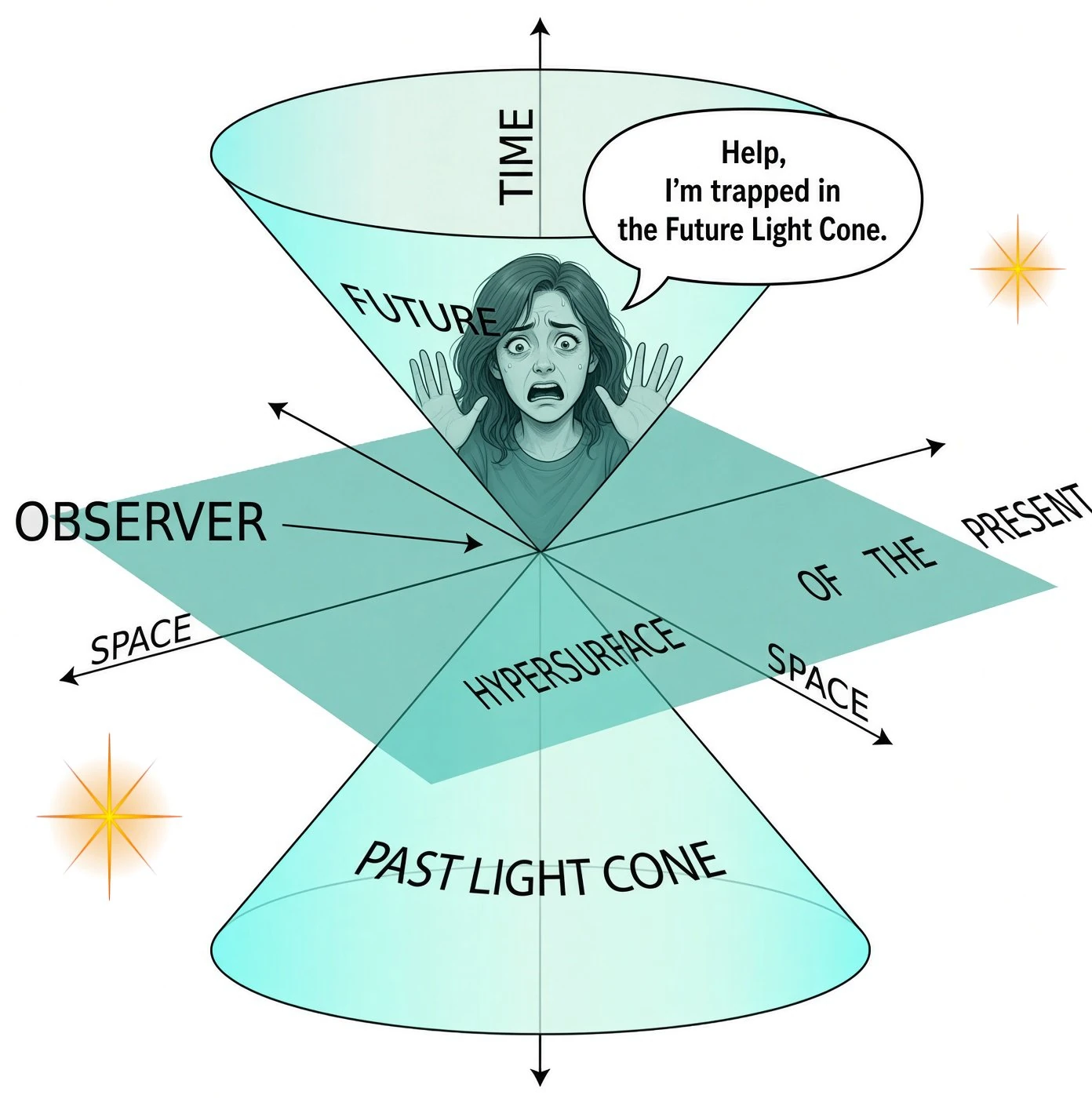
Yet the time direction keeps rules that no direction in space has. You can walk back to where you were. You can’t walk back to when you were. Take two events. If a signal could travel from one to the other, every observer agrees which came first. If not even light could cover the distance in the time between them, observers can disagree about their order. The light cone draws that boundary, and it is the same for everyone.
The light cone. Everything inside the upper cone can be affected by what happens here; everything inside the lower cone could have affected it. Outside, “elsewhere”, no cause can connect to this point, and observers disagree about what happens before what. Then there is a stranger fact. The basic laws of physics work the same forwards and backwards. A film of two billiard balls colliding looks right played either way. A film of an egg breaking does not. The arrow we feel, eggs that break and don’t unbreak, memories of the past and none of the future, comes from somewhere else: the universe began in a state of very low entropy, and everything since has been running downhill from it. The philosopher David Albert called this the past hypothesis (2000). It explains the arrow. Nobody knows why it is true.
Now take the slope away and look at what is left. A universe at equilibrium, the heat death physicists expect at the very end, still obeys the same laws. But it has no gradients, so no work can be drawn from it, not even by the one-bit engine Leo Szilard imagined in 1929. It holds no records, because a record is a mark that hasn’t yet been smoothed away, and marks form only on a slope. And it has no direction: nothing comes before anything else in any way that matters. Directed time, usable energy and useful information disappear together. They look like one asymmetry seen from three sides. Where there is no slope, there is nothing to know and no one to know it.
Part twoThe timeless theories
Several serious theories go further. They say time is not fundamental at all.
- In the block universe, the picture many physicists take from relativity, past, present and future all exist together. Nothing flows. We are inside a four-dimensional shape, and “now” is only the place in it where we happen to be, as every frame of a film sits on the reel at once. Einstein seems to have believed this. When his friend Michele Besso died in 1955, he wrote to Besso’s family: “For us believing physicists the distinction between past, present, and future only has the meaning of an illusion, though a persistent one.” He died a month later.
- When Bryce DeWitt wrote down an equation for the quantum state of the whole universe (DeWitt, 1967), time dropped out of it. The universe taken as a whole does not change.
- Don Page and William Wootters then asked how anything happens at all (Page and Wootters, 1983). Their answer was to split the universe in two: a clock, and everything else. Each part on its own is static. But the two are correlated, and change is what the rest looks like when it is read against the clock. A tabletop experiment with entangled photons later showed a small version of this (Moreva et al., 2014).
- Julian Barbour (The End of Time, 1999) argues that the universe is a collection of “nows”, each complete in itself. Some of them he calls time capsules: arrangements so full of records that they look like a history, the way the layers in a cliff look like a story of floods. On this view a memory, or a fungus’s chemical map of the soil, isn’t a trace left by time. It is what gives the impression of time. Alain Connes and Carlo Rovelli proposed that the flow of time comes from incomplete information: a being that saw every detail would see no flow at all (Connes and Rovelli, 1994). If that is right, it closes a loop. Living things keep a compressed record of the past in order to predict the future. Here the compressing, the not seeing everything, may be what produces a past and a future in the first place.
The block universe, flattened to one dimension of space. Observers moving differently slice it into different “nows”. A life is a shape that runs through it, and the slope from low to high entropy gives that shape a direction. Look at how much survives in the block. Energy becomes gradients across its regions. Information becomes correlation: one region, the chemical map inside a hypha, matches another, the place where the sugar is. Prediction becomes correlation that points up the entropy slope. And life becomes a shape that holds itself together along that slope, like a whirlpool in a photograph: still on the paper, but there only because water was running through it. What all of this needed was never the flow of time. It was the slope.
These ideas don’t stand on equal ground. The block universe is mainstream. Page and Wootters is respected but debated. Barbour’s nows and thermal time are serious ideas that no one has yet tested.
The argument is much older than physics. Twenty-five centuries ago Parmenides argued that change is impossible and that reality is one, unchanging and timeless. Heraclitus answered that everything flows, and that no one steps into the same river twice. In 1908, the same year as Minkowski’s lecture, the philosopher J. M. E. McTaggart gave the debate its modern terms (The Unreality of Time). Time can be described as a flow, with events moving from future through present into past, or as a fixed order of earlier and later. The block universe keeps the order and drops the flow. The question is whether anything is lost.
Each of them relocates change instead of removing it. The block turns “first this, then that” into “here this, there that”, along one more axis. Page and Wootters put time inside a clock, and the clock still ticks. Barbour’s records still have to be read in order. Thermal time explains the flow by our ignorance, but an ignorance that unfolds how? Henri Bergson raised this objection in 1889 (Time and Free Will): physics draws time as a line, then forgets that the drawing isn’t the thing, the way a map of a river is dry. Lee Smolin raises it from inside physics in Time Reborn (2013). The block view answers that becoming is simply what it is like to be inside a slope. Bergson and Smolin answer that becoming is real and the geometry is a map of it. No experiment has settled it. That is why every timeless theory feels as if it is dodging something. It might be.
Part threeWhere the flow shows up
If physics keeps the order and drops the flow, the flow must come from somewhere. The nearest place to look is whoever is doing the perceiving. Here, for once, there are experiments and not only arguments.
The present is assembled. The “now” you experience isn’t an instant. William James called it the specious present (The Principles of Psychology, 1890): a short window that holds a few moments together, long enough to hear a melody rather than separate notes. Ernst Pöppel put the window at about three seconds (Pöppel, 1997). Inside that window the brain doesn’t only record; it edits. In the flash-lag effect, a flash shown level with a moving object seems to trail behind it, because the brain decides what happened at a moment using information from the following eighty milliseconds or so (Eagleman and Sejnowski, 2000). Your present is partly written after the fact, like a letter dated in the morning and finished at night.
Felt duration is a reconstruction. In one experiment, volunteers fell backwards 31 metres into a net. Afterwards they judged their own fall to have lasted about a third longer than other people’s. Strapped to each forearm was a small display flashing digits just too fast to read. During the fall the digits stayed unreadable. The fallers had not perceived more. They had remembered more densely (Stetson, Fiesta and Eagleman, 2007).
Different bodies, different nows. Smaller animals with faster metabolisms resolve finer slices of time. Many flies can see flicker several times faster than we can, which is part of why they are so hard to swat (Healy et al., 2013). The hand that seems quick to us arrives slowly to the fly. There is no single rate at which the present arrives.
None of this settles whether time flows. A brain that builds its present from a short, edited window would feel flow in a block universe, and it would feel the same in a world where becoming is real. But it moves the question. The flow we experience is at least partly made by the perceiver, from a compressed record stitched together slightly late. That fits the thermal-time idea above: a being that sees only part of the picture, and compresses it, is exactly the kind of being that feels time pass.
Part fourThe circle
So try to go underneath. Every definition of time leans on space, or on time itself. “Geometry” means extension across something. “Slope” means change along something. The attempts to build spacetime out of something more basic all meet the same wall:
- Causal sets start from points and an order: this precedes that. Rafael Sorkin’s slogan is “order plus number equals geometry”. But order is already time-like.
- Building space out of quantum entanglement (Van Raamsdonk, 2010) starts from correlations between parts. But “parts” already means a distinction: this, not that.
- Rewriting systems, like the Wolfram physics project, build space from networks of relations, but the rewriting goes in steps. Steps are time again.
What survives every attempt is two things: difference (this is not that) and relation (this connects to that). Put simply, space is relation without direction: A is next to B, and B is next to A. Time is relation with direction: A comes before B, and B does not come before A. That would make space and time neither one thing nor two, but the symmetric and the asymmetric form of the same relating.
This also tells us exactly how much survives without time. Gregory Bateson defined information as “a difference which makes a difference”. So there are three cases. With no distinctions at all, nothing holds: no information, no gradient, no life. With distinctions but no order, pattern and correlation survive (this part matches that part), but prediction, value and cost don’t, because each of them needs a before and an after. With distinctions and an asymmetry, everything works. That last case is the one physics actually supports.
But this only moves the circle back one step. “Difference” and “relation” can’t be defined without using them. Immanuel Kant thought this was unavoidable: space and time are the forms through which we think anything at all (Critique of Pure Reason, 1781), so we can’t think our way outside them, any more than an eye can see itself.
Part fiveWhere the old traditions start
Some traditions didn’t try to get underneath that floor. They began there.
The I Ching starts from change, not things. The Book of Change goes back, in its oldest layers, to around 1000 BC. Its unit is a single line, broken or unbroken: one difference, the smallest mark a brush can make. Six lines make a hexagram, and the 64 hexagrams are situations, each in the middle of turning into another. Things are passing states of change, not the other way round.
In 1701 the Jesuit Joachim Bouvet, writing from Beijing, sent Gottfried Leibniz a diagram of the hexagrams (the letter). Leibniz had already worked out binary arithmetic. Bouvet pointed out that if you read broken lines as 0 and unbroken lines as 1, the diagram counts from 0 to 63. The letter took seventeen months to arrive. Leibniz published his paper on binary in 1703, the year it reached him, and included the match. The bit and the Book of Change met three centuries ago, on paper that had crossed the world by ship.
0
000000
Kun1
000001
Bo2
000010
Bi3
000011
Guan…63
111111
QianBouvet’s reading: each hexagram, read from the bottom line up, is a six-digit binary number. Jain logic gives truth an address. Jain philosophers developed syādvāda, a logic of seven qualified claims: in some respect it is; in some respect it is not; in some respect it is and is not; in some respect it can’t be expressed; and combinations of these. Every truth is tied to a standpoint. “True and not true” is not a contradiction, because each holds from somewhere. The block universe does the same with places in spacetime. Physics doesn’t need real contradictions either. Quantum superposition is often described as something being true and not true at once, but that is a misreading: a superposed state has no definite value for that property, which is different from having both.
Nāgārjuna empties the floor. The second-century Buddhist philosopher Nāgārjuna argued that nothing exists in itself: everything exists only through its dependence on something else. He called this absence of own-being emptiness, śūnyatā. That is relation all the way down. Then he refused to make relation the new foundation: emptiness is empty too. In the Mūlamadhyamakakārikā he lists four answers to an ultimate question (it is, it is not, both, neither) and rejects all four. Not out of confusion, but because the question assumes a thing with fixed properties to ask about.
The Dao won’t be named. In Daoist cosmology the limitless, wuji, comes before the first split into yin and yang. The Dao De Jing opens: “The Dao that can be spoken is not the eternal Dao.” It says in one line what Kant needed a book for.
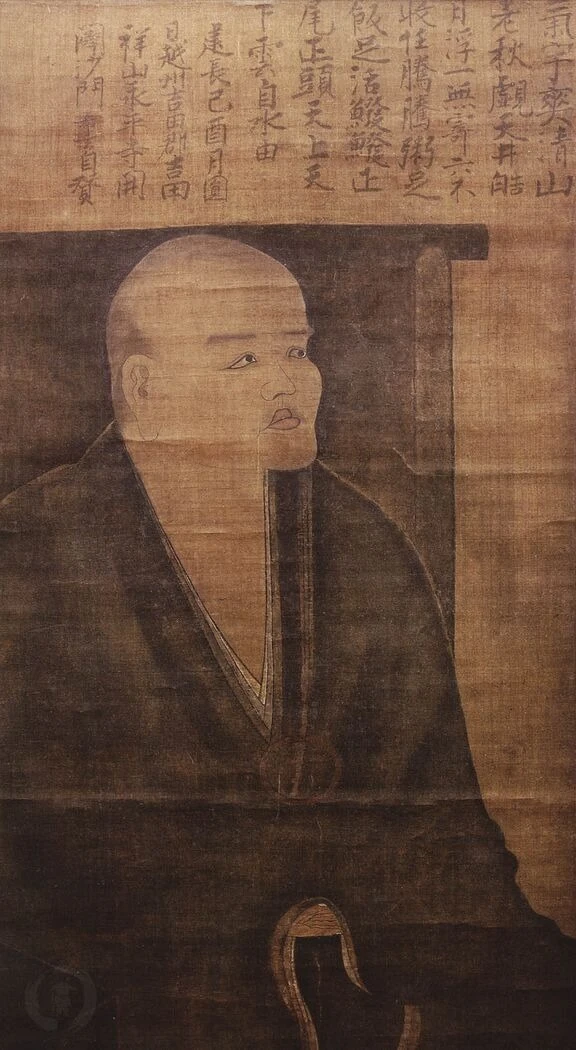
Dōgen watching the moon. 13th-century portrait, Hōkyō-ji. Public domain. Dōgen makes time and being one. The Japanese Zen master Dōgen wrote an essay in 1240 called Uji, usually translated as “Being-Time”, collected in the Shōbōgenzō. Its claim is that time isn’t a container things pass through: things are time, and time is things. Seven years earlier, in Genjōkōan, he gave an image that reads like the block universe written seven centuries early. Firewood burns to ash, and ash doesn’t turn back into firewood. But don’t think of the ash as after and the firewood as before, he says. Firewood stays in its own place as firewood, with its own before and after, and ash stays in its place as ash. Each moment is complete where it is, and the order still holds.
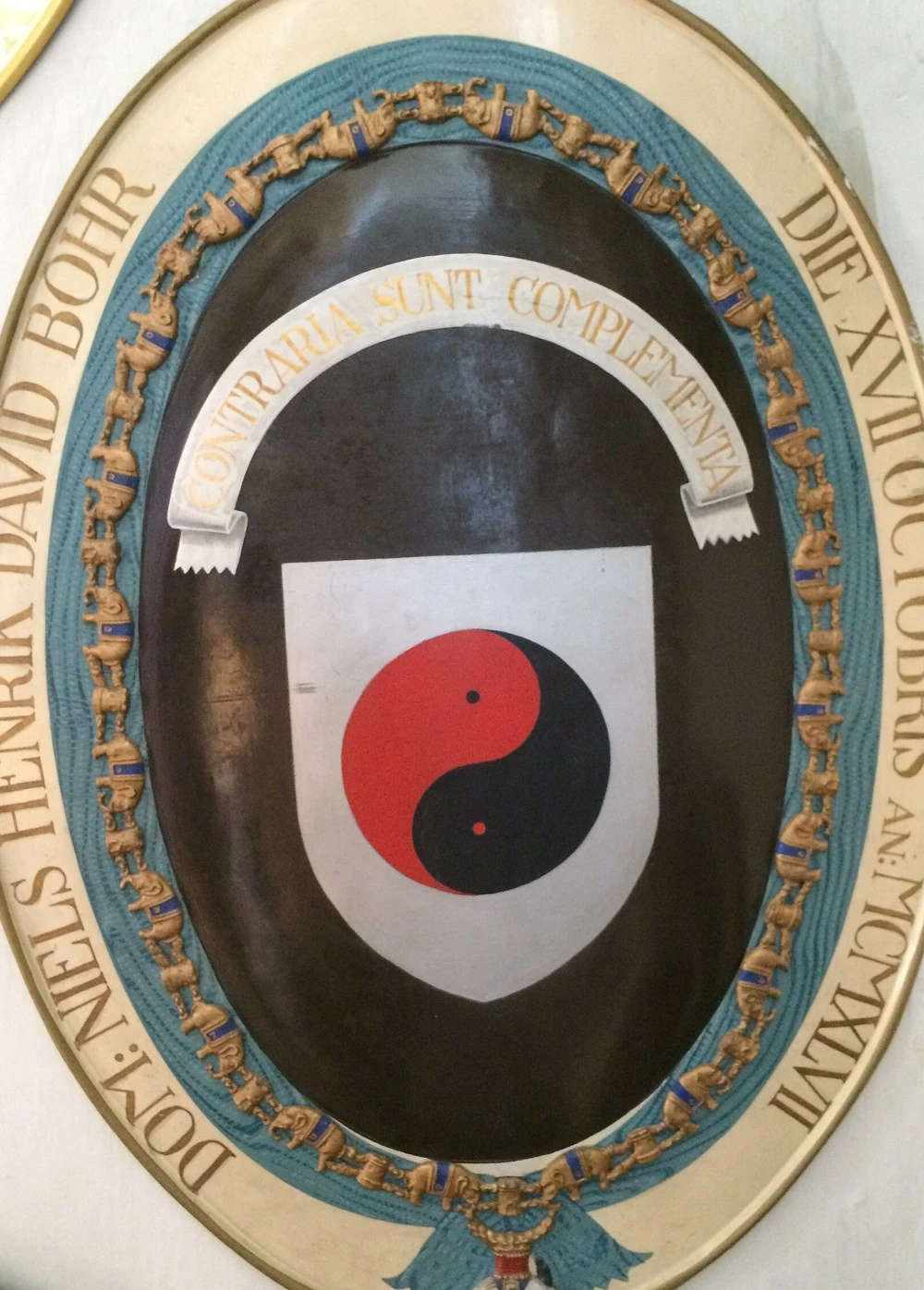
Niels Bohr’s coat of arms, 1947, in Frederiksborg Castle Church. Photo: Kim Bach, CC BY-SA 4.0. Physics has brushed against all of these. When Niels Bohr received the Order of the Elephant in 1947, he designed his coat of arms around the yin-yang symbol, with the motto contraria sunt complementa: opposites are complementary. It still hangs in a Danish castle church, among the painted shields of the order’s other knights. Carlo Rovelli’s relational reading of quantum mechanics says objects have properties only relative to other objects. In Helgoland (2020) he gives a chapter to Nāgārjuna.
These are parallels in structure, not evidence. Nobody in ancient China or India derived quantum theory, and the traditions don’t need physics to be taken seriously. What they share with the best modern thinking is a refusal to treat things as the bottom layer.
CodaBefore completion
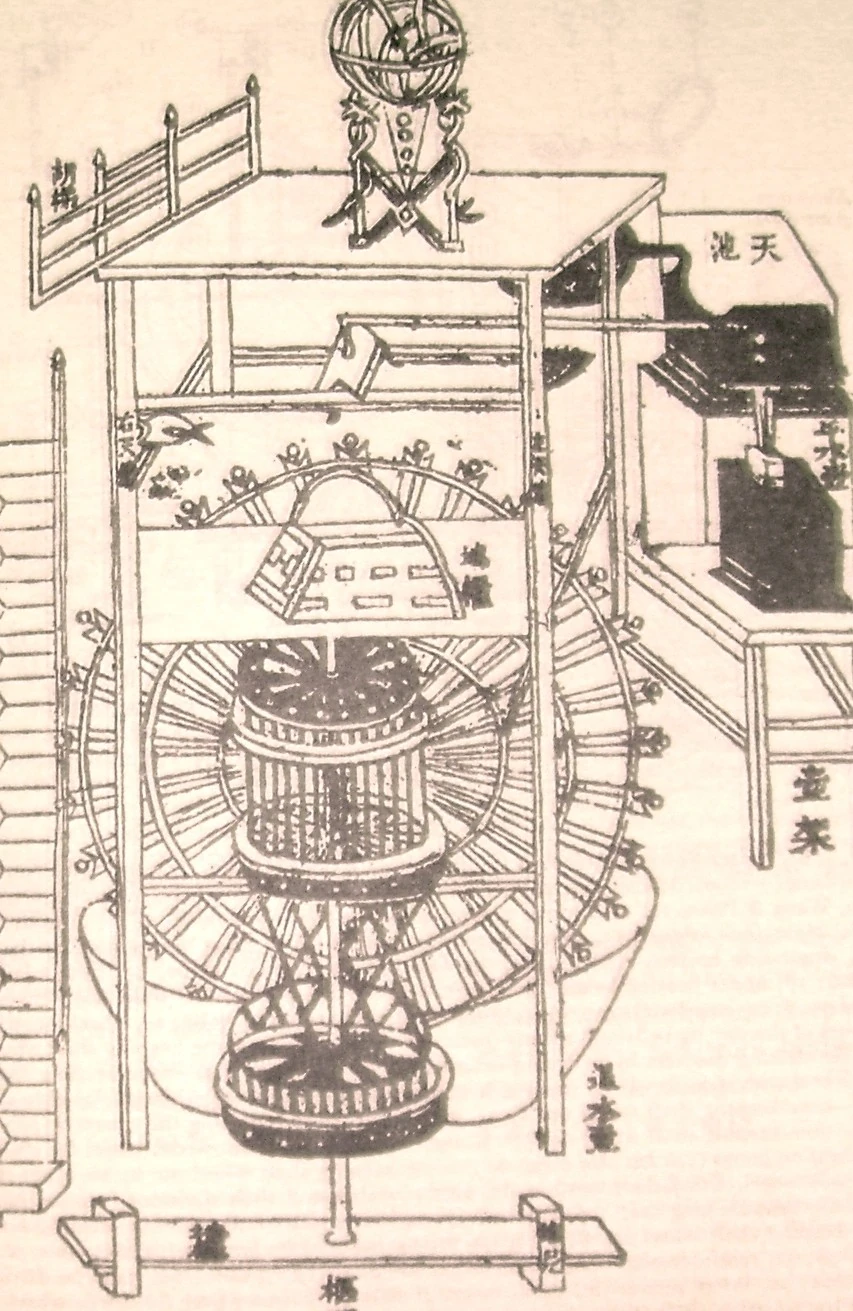
Su Song’s astronomical clock tower in Kaifeng, from his 1092 treatise. A water wheel turned an armillary sphere and struck the hours. Public domain. We measure time better than anything else. For a thousand years people have built ever better clocks, from Su Song’s water-driven clock tower in 11th-century China to today’s optical clocks, which run so evenly that they would drift by less than a second over the age of the universe. Su Song’s tower is long gone; the woodblock drawings of it survive. And we still can’t say what time is. Augustine put it this way around the year 400:
“What then is time? If no one asks me, I know; if I wish to explain it to one who asks, I know not.”Augustine, Confessions, Book XI
That isn’t a gap the next theory will close. Every attempt runs into the same place: difference and relation, which can’t be defined without themselves. Physics relocates change, into a dimension, a clock or our ignorance. The older traditions treat the limit as the finding. The I Ching makes it motion, the Jains make it perspective, Nāgārjuna says the floor is empty, Dōgen says time and being are one, and the Dao says it can’t be named.
The Book of Change doesn’t end on an answer either. Its 63rd hexagram is called After Completion. The 64th, the last, is Before Completion.
“Things cannot be exhausted; therefore the sequence closes with Before Completion.”
物不可窮也,故受之以未濟終焉 — Xugua, the traditional commentary on the order of the hexagrams
-
What a Bit Can Unlock
What mycelium teaches about energy, matter and information.
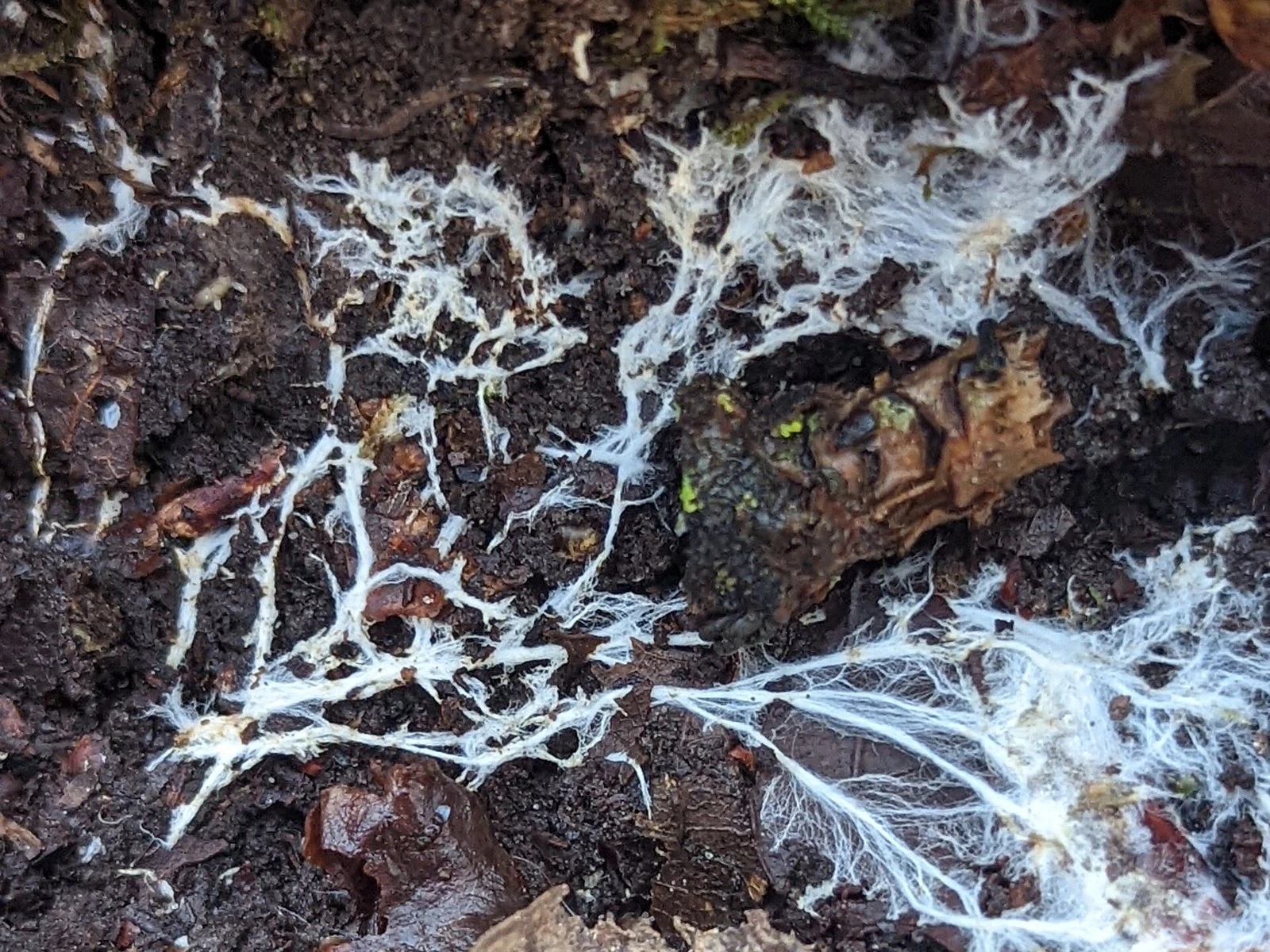
Mycelium threading through leaf litter. Photo: FungiFriendly, CC BY-SA 4.0. This started as a question about fungi: what does a mycelium run on? The answer is more than one thing. Living things deal in energy, in materials and in information, and these behave like separate currencies. Working out how they relate leads from the forest floor to the physics of a single bit, and to Leo Szilard, the man who also conceived the nuclear chain reaction. Along the way it turns up something about mycelium that’s easy to overlook.
Part oneThree currencies
Staying alive is work. A stone left alone stays a stone. A living thing left alone falls apart. Ilya Prigogine called such things dissipative structures: patterns, like a flame or a whirlpool, that exist only while energy flows through them. Humberto Maturana and Francisco Varela called life autopoiesis, self-making: a system that keeps rebuilding the parts that keep it going. Mycelium shows this plainly. Hyphae grow at their tips while older sections are broken down and recycled, so the network is less a thing than an ongoing process. Something has to pay for all that rebuilding, and life pays in more than one currency.
Energy is the universal one. Almost all of it starts as sunlight. Plants turn it into sugars, and every cell spends it as ATP. The exception is life at deep-sea vents, which runs on chemical energy.
Materials are separate currencies: nitrogen, phosphorus, water. Mycorrhizal fungi, the ones that partner with plant roots, mostly trade those. They give plants phosphorus and water, and get sugar (carbon) back. That trade exists because there are two currencies: each side has what the other lacks.
It’s a market, not a gift economy. Plants send more carbon to the fungi that deliver more phosphorus, and fungi send more phosphorus to the roots that pay more carbon (Kiers et al., Science 2011). Cheaters get cut off. The romantic “wood wide web”, where trees share through fungi like a family, is debated: a 2023 review (Karst et al.) found the field evidence much thinner than the popular story.
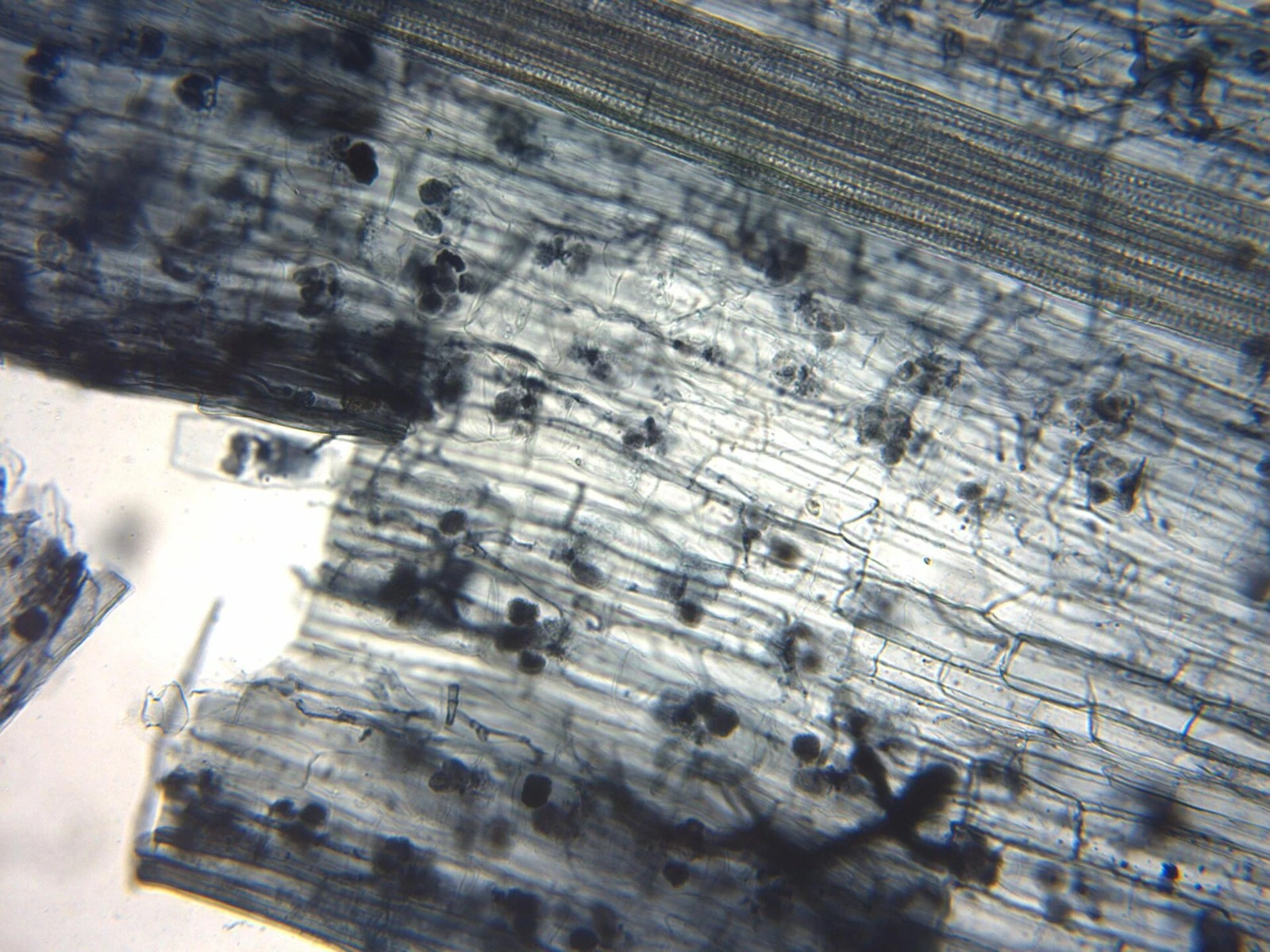
The marketplace up close: plant root cells colonised by an arbuscular mycorrhizal fungus. The dark knots are fungal structures inside the plant’s cells, where sugar and phosphorus change hands. Photo: Msturmel, public domain. Signals cost energy but aren’t energy. Electrical spikes in mycelium run on ion gradients that ATP pumps maintain. So energy pays for the signal, but the signal’s value is information: what to do, where to grow. The information pays back in energy and survival. Information is a pattern, not energy itself, but the two trade against each other.
Part twoWhat is information, then?
It’s the arrangement, not the stuff. Rearrange the same letters and you get a different message, with the same ink and the same energy. Information lives in the relations between parts.
It always needs a host. No floating information exists. It’s cut into stone, held as voltage in silicon, written in DNA, kept as an ion gradient in a hypha. Rolf Landauer’s motto: “information is physical.” Take away the carrier and the information is gone.
Meaning needs a reader. In Shannon’s sense a crystal holds a pattern whether anyone looks or not. But a chemical trail means “food here” only to a fungus that can read it. To a rock it means nothing. And the reader pays: it burns ATP to keep its reading machinery alive.
Information trades against energy. Landauer’s principle: erasing one bit costs at least kT ln 2 of energy, about 3 × 10⁻²¹ joules at room temperature (Landauer, 1961). Szilard’s engine shows the reverse: knowing one bit lets you extract up to kT ln 2 of work (Szilard, 1929). Put one gas molecule in a box, slide in a wall, find out which side it’s on, and let it push the wall. So information isn’t merely carried by energy. It’s physical, and it trades against free energy: knowing something lowers entropy, which raises the work you can extract. There’s no free lunch. To repeat the trick you have to erase the bit, and erasing pays back what you gained (Bennett, 1982).
one bit ⇄ kT ln 2 ≈ 3 × 10⁻²¹ J
The exchange rate between information and energy at room temperature
1. One molecule in a box.
2. Slide in a wall.
3. Measure which side: one bit.
4. It pushes the wall: up to kT ln 2 of work.
Life pays far above that floor. kT ln 2 is tiny: splitting one ATP molecule releases about twenty times as much. And a cell is warm, wet and noisy. To send a signal that survives the thermal jiggling it has to shout, pumping thousands to millions of ions for one clear spike. Neurons, the best-measured case, spend between ten thousand and ten million ATP per bit (Laughlin et al., 1998). That puts living signalling a hundred thousand times or more above Landauer’s limit. The extra buys reliability and speed.
Energy per event, in multiples of the Landauer limit (log scale)
Erasing one bit, the physical minimum1×Splitting one ATP~20×A neuron sending one bit10⁵–10⁸×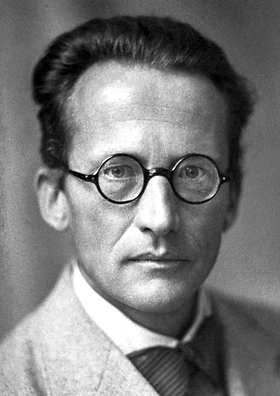
Erwin Schrödinger, 1933. Nobel Foundation, public domain. Information is leverage. A map can’t power a car, but the right map finds the well. So a cell’s information is worth something through behaviour, not through its own tiny thermodynamic value: knowing where the food is saves far more energy than the bit itself could ever pay out. The fungus spends a little ATP maintaining a pattern that maps the soil, and that pattern decides where its large budgets of energy and material go next. Schrödinger wrote in What Is Life? (1944) that “what an organism feeds upon is negative entropy.” Léon Brillouin later tied negative entropy to information. Seen that way, a living thing feeds on energy and on knowing where to spend it.
A bit has two prices. Landauer gives one exchange rate: a bit is worth at most kT ln 2 joules. There is a second, and it’s the one that matters for life. In 1956 John Kelly, working at Bell Labs, showed that a gambler with a private tip can grow their money faster, and that the extra growth rate is capped by how much information the tip carries about the outcome (Kelly, 1956). Matina Donaldson-Matasci, Carl Bergstrom and Michael Lachmann showed that, under comparable conditions, the same holds for organisms: a cue about the environment can raise a lineage’s growth rate by at most the information it carries (Donaldson-Matasci et al., 2010). So a bit has a tiny price in joules and a potentially large price in growth. Physics fixes the first. The second depends on what the bit lets you do.
Underneath, there’s only one currency. Strictly, physics counts information as a form of free energy: a system you know more about holds more extractable work (Parrondo, Horowitz and Sagawa, 2015). So the deepest currency is free energy. But in a living thing the bit’s own share is a rounding error, while what it steers is everything. That’s why, in practice, it pays to track information as its own currency.
Knowing has to pay for itself. Senses and brains are judged by one rule: they’re worth keeping only if what they tell you saves more energy than they cost. The human brain is about 2% of body weight and burns about 20% of the body’s energy. So evolution keeps nervous systems lean: sparse firing, cheap codes, no thinking without need. An eye that never finds food is a luxury, and luxuries get cut. Physics adds a sharper version: a system that keeps memories of its past which don’t help predict its future must waste energy because of them (Still et al., 2012). Useless memory has a heat bill, so being efficient and predicting well turn out to be closely linked.
Information is a bet on the future. In Shannon’s theory, how much information a message holds is how short you could make it: information and compression are two sides of one idea. A living thing can’t afford to keep everything, so it keeps a compressed record of its past, and only the parts that predict its future are worth the cost (Bialek, Nemenman and Tishby, 2001). Seen this way, a fungus’s information is a map of gradients projected forward: not where the sugar is, but where it will be when the hypha gets there. The gradients exist either way. What the map changes is how much of them can be harvested.
Time does three jobs here. It makes information possible: records and memories form only because entropy runs one way, which is why we remember the past and not the future. It makes information necessary: the world changes, so maps go stale and have to be redrawn, and every overwrite pays Landauer’s price. And it makes information expensive: Landauer’s minimum is reachable only by computing infinitely slowly, while a fungus needs to know where the food is before a competitor gets there. That’s a large part of why life runs so far above the floor.
Part threeWhat a bit can unlock
“… what hep humorists here are already calling ‘Critical Mass’ (get it? not too many did in 1945, the Cosmic Bomb was still trembling in its earliness, not yet revealed to the People, so you heard the term only in the very superhepcat-to-hepcat exchanges).”Thomas Pynchon, Gravity’s Rainbow (1973)
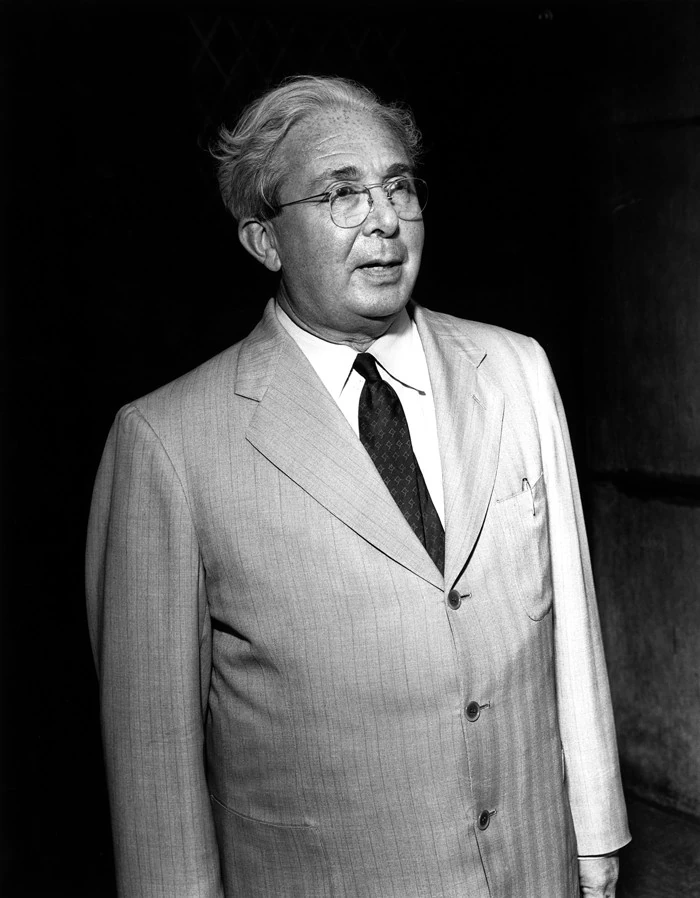
Leo Szilard. U.S. Department of Energy, public domain. The same Szilard stands at both ends. In 1929 he showed that one bit is worth almost nothing: kT ln 2 of work, about 3 × 10⁻²¹ joules. In 1933, waiting at a traffic light in London, he saw that a neutron chain reaction could release enormous energy. He patented the idea in 1934, and in 1939 he drafted the letter Einstein signed to Roosevelt. By 1945 “critical mass” was the insiders’ joke in Pynchon’s novel. A bit on its own buys almost nothing. The right piece of knowledge, applied in the right place, released enough energy to destroy a city.
A bit doesn’t contain energy. It releases it. The bomb needs three things. A store: energy held in a metastable state, here in uranium nuclei. A trigger: one neutron, one “go”. And gain: each split has to set off at least one more. Critical mass is the amount of uranium at which that gain reaches one and the reaction sustains itself; a bomb pushes it well above one. The trigger’s own energy is irrelevant. What it can unlock depends on the size of the store and on the gain.
Life runs on the same pattern. ATP is a store waiting to be spent, enzymes are triggers, and signalling cascades supply the gain. A single photon can make a rod cell in your eye respond, because each step of the cascade multiplies the signal (Baylor, Lamb and Yau, 1979).
Bomb Cell Mycelium Store Uranium nuclei ATP, sugars Dead wood, soil carbon Trigger One neutron An enzyme, a photon An enzyme, a signal at a hyphal tip Gain Chain reaction Signalling cascade Growth that reinforces what pays Mycelium sits on the largest store on land. Soils hold more carbon than the atmosphere and all plants combined, much of it from dead plant matter: stored sunlight. Decomposers decide whether that store stays locked or is released, and for wood the decomposers are mostly fungi. White-rot fungi are among the very few organisms that can break down lignin, the toughest part of wood. Some researchers argue that when fungi evolved lignin-cracking enzymes, less wood got buried, which helped end the great coal-forming era of the Carboniferous (Floudas et al., Science 2012). Others think climate and geology mattered more (Nelsen et al., PNAS 2016). That it’s a serious debate is the point: a handful of genes is a candidate for steering the planet’s carbon.
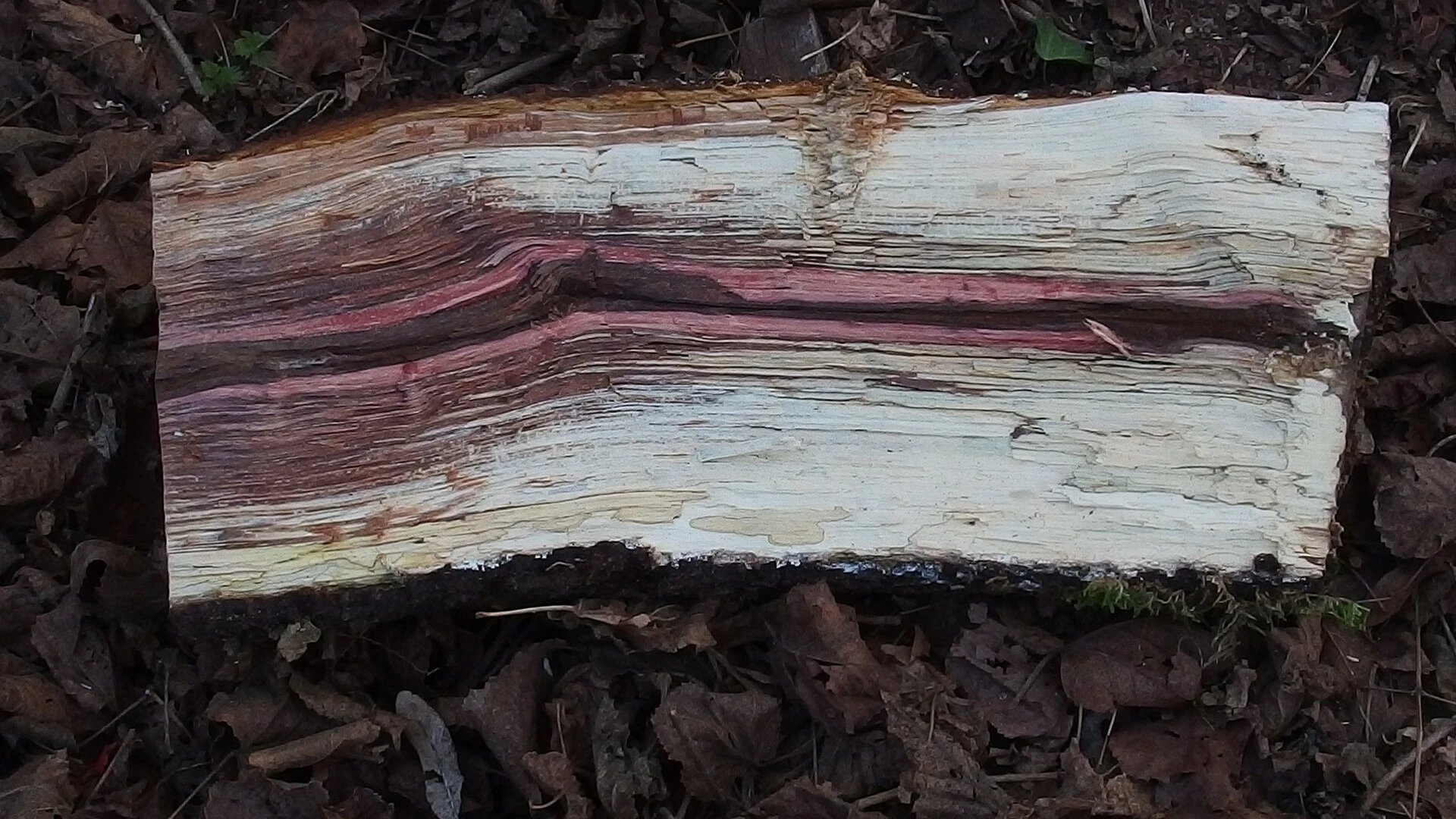
White rot in oak. The pale wood is where fungi have broken down the lignin, the part of wood almost nothing else can digest. Photo: Auró, CC BY-SA 4.0. And it steers a flow measured in gigatonnes. Plants send an estimated 13 gigatonnes of CO₂-equivalent a year to their mycorrhizal fungi, roughly a third of annual fossil-fuel emissions (Hawkins et al., Current Biology 2023; the estimate is uncertain). Inside the network, paths that find food get more growth and more transport, so a small signal at a hyphal tip turns into a large reallocation. That’s gain.
A bomb wants gain above one. Life seems to want it near one. Below one, signals die out. Above one, they run away, and a bomb is built to run away. Living systems need to stay responsive without exploding, and there’s evidence that some sit close to the edge. In slices of rat cortex, bursts of activity spread as “neuronal avalanches” whose statistics look like a system poised at a gain of about one (Beggs and Plenz, 2003). When a system tunes itself to that edge, it’s called self-organised criticality. The idea is still debated for brains and untested for fungi. But it marks the real difference between a bomb and an organism. Both use a store, a trigger and gain. Life keeps the gain at the edge, where a small signal can matter and nothing blows up.
So what are we overlooking? We tend to see mycelium as a network that carries things. It’s better seen as a control system sitting on a vast reservoir of stored energy. Its information is cheap, and what it controls is measured in gigatonnes. That’s a way of seeing, not yet a measurement: nobody has worked out how much of that flow is steered by what fungi sense and signal, rather than by plain growth and chemistry. But it’s the right question to ask. Szilard found both ends of that within a few years. Fungi have been running the quiet version for over 400 million years.
Information is worth what it can unlock, not what it weighs.
In shortThe whole picture
Energy
pays
Free energy: sunlight, sugar, ATP. Every cell spends it.
Materials
trade
Nitrogen, phosphorus, water. Scarce in different places, so they get exchanged.
Information
steers
Patterns and signals. Cheap to hold, and they decide where the rest goes.
Why does having more than one currency matter? The material currencies are what make trade, specialists and coexistence possible. Ecology has a name for the alternative: competitive exclusion (Gause, 1934). When species compete for one limiting resource, the best competitor eventually wins and the rest disappear. With two or more, different species can specialise on different ones and live side by side (Tilman, 1982). The catch is that this only works where they actually compete: without competition, a second resource just favours generalists. Where they do, a second currency is the step from a single winner to an economy.
So, back to the question this started with: what does a mycelium run on? Sugar, from the plants it partners with or the dead wood it breaks down. Phosphorus and water, traded back and forth. And a web of signals that costs almost nothing to keep, and decides where all of it goes.
-
As creatures get more complex, the light in their myelin shifts red
In a study published in 2009, to photograph a man by his own light, Masaki Kobayashi and his colleagues in Sendai first took away all other light. The volunteer sat in the dark room for fifteen minutes before anything was recorded. Then a camera cooled far below freezing looked at him for twenty minutes.
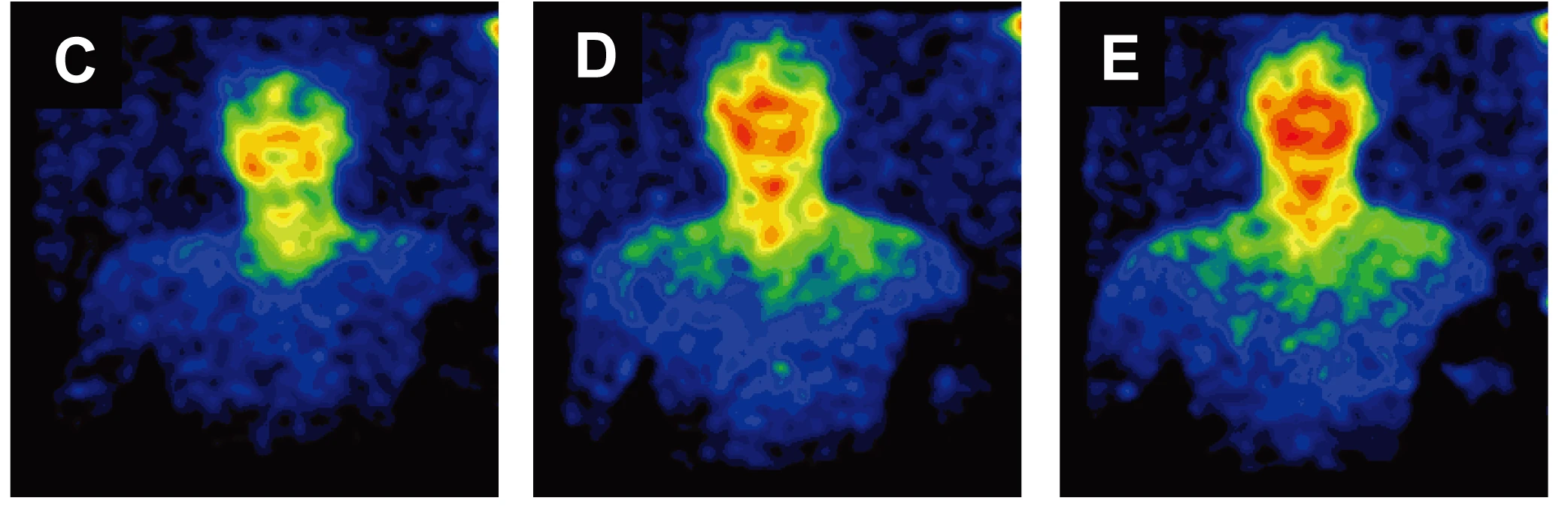
A man's face and shoulders imaged in darkness by their own emission, at 10:10, 13:10 and 16:10. Kobayashi et al., PLoS ONE 2009, CC BY. It collected a few hundred photons per square centimetre per second, about a thousand times less than the eye can see. The face was brighter than the body, the mouth and cheeks brighter than the rest of the face, and the whole figure was brightest around four in the afternoon.
These photons are called biophotons, or, more soberly, ultraweak photon emission. There is nothing occult in them. They are a by-product of chemistry. Oxidation in the cell leaves some molecules in an excited state, and a few of them return to rest by giving up a photon. All living tissue does it. The brain does it too, and the brain is full of a structure that an optician would recognise.
The sheath
A myelinated axon is a thin thread of cytoplasm around which another cell has wound its own flattened membrane, many times, like paper rolled tight around a pencil. The wraps are mostly fat.
Their refractive index is higher than that of the axon inside and of the fluid outside. Light travelling in a denser layer, at a shallow enough angle, is reflected at the boundary and stays in. An optical fibre works the same way.
In 2016 Sourabh Kumar, Christoph Simon and their colleagues calculated that a myelin sheath could carry biophotons this way along an axon, even when the axon bends and the sheath is uneven.
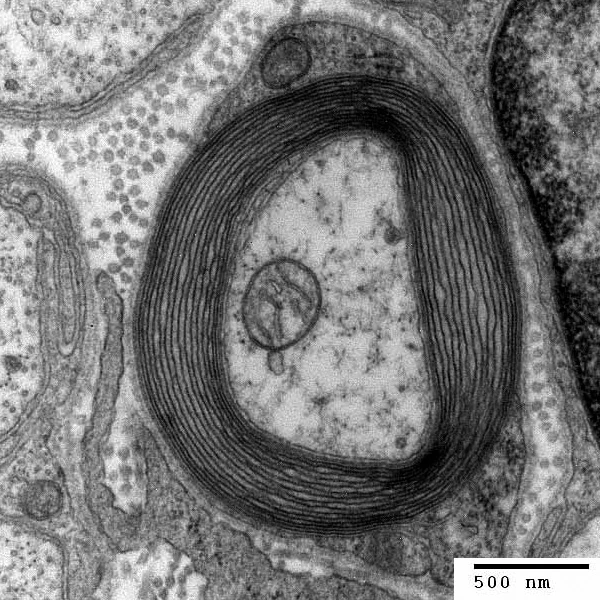
A myelinated axon cut across. Each dark line is one turn of membrane. Electron Microscopy Facility, Trinity College. Public domain. 
Laser light kept inside a glass rod by reflection at its surface. Angel Toshkov, CC BY-SA 3.0. Six brains
The same year, in Wuhan, Zhuo Wang, Jiapei Dai and their colleagues measured the colour of the biophotons that brains give off. They kept slices of brain alive in solution and gave them glutamate, the transmitter that excites most neurons. The faint light passed through a slit and a grating onto a camera cooled to −95 °C, and its spread on the sensor gave its wavelengths.
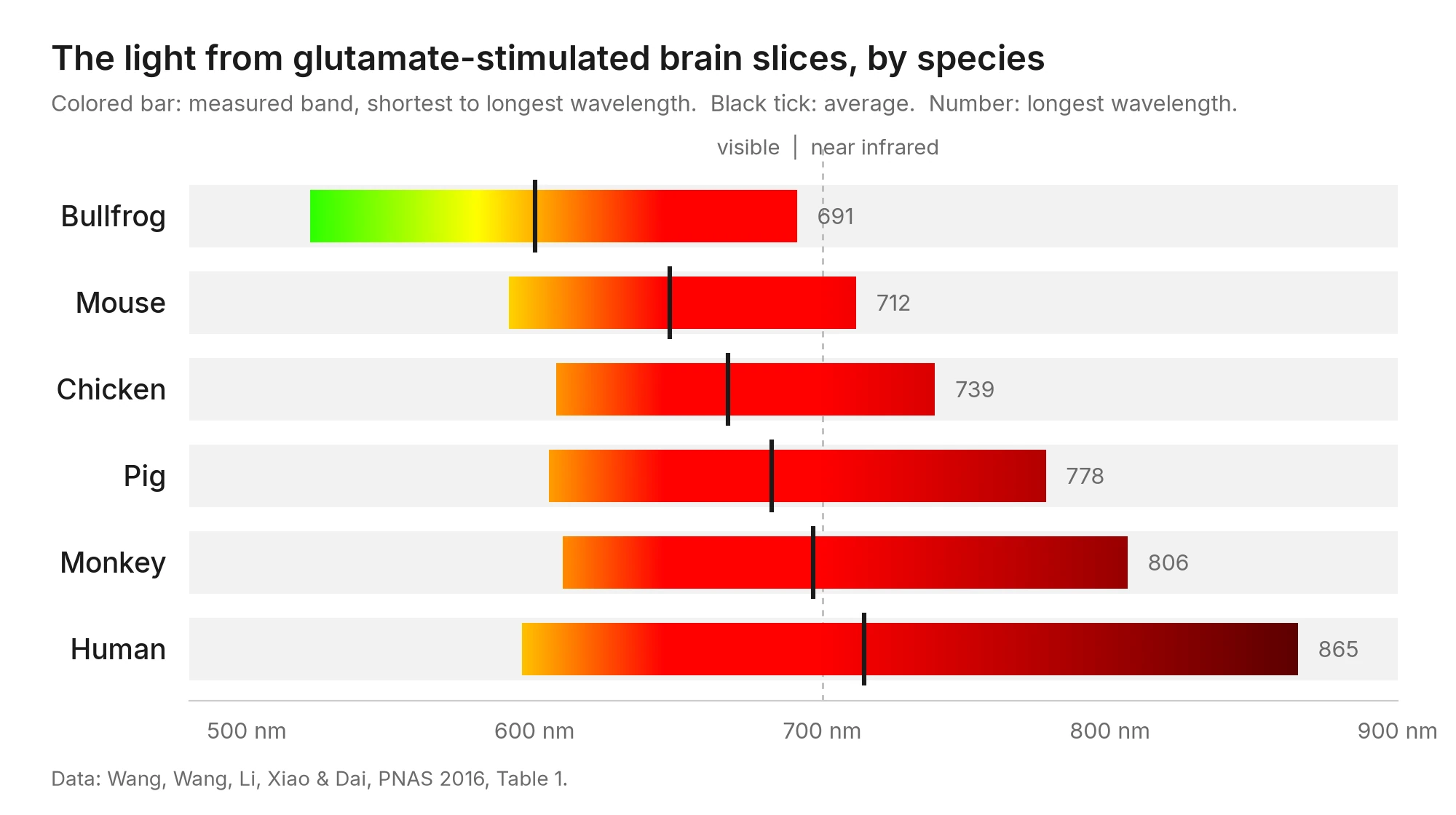
They did this for six animals. In the bullfrog the light ran from 522 to 691 nanometres, from green through orange to red. In human tissue it ran from 596 to 865, well past the red into the infrared, where the eye sees nothing. Mouse, chicken, pig and monkey fell between them, in that order.
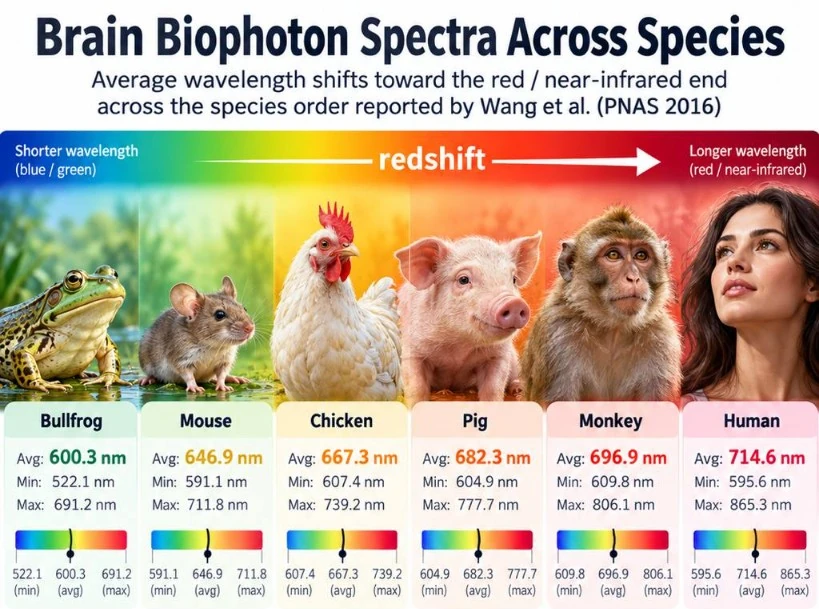
The six brains, with the average, shortest and longest wavelengths for each. Values from Wang et al., PNAS 2016, Table 1. Infographic found online, source unknown. Drawn to scale, the bands show something the averages hide. The short end hardly moved. The long end moved out.
The number of turns
A colleague put the idea to me in one line:
There could be a relationship between nervous system architecture and the spectral properties of biophotons.
One such relationship has been calculated. In 2022 Haomin Zeng and colleagues, also in Wuhan, worked out how light would travel in such a sheath. They found it carries only a narrow band of colours, about ten nanometres wide, and that the band is set by the shape:
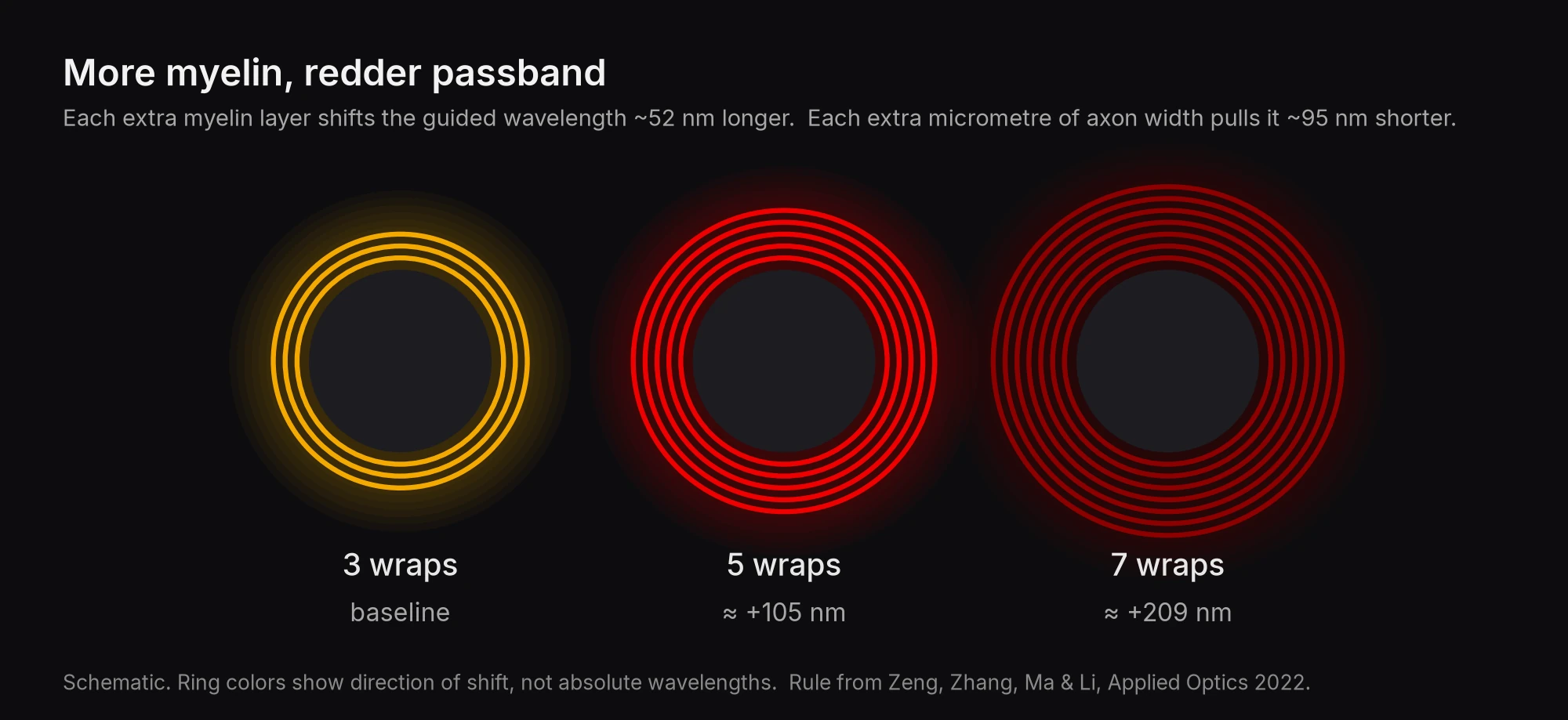
One more layer of myelin moves the band about 52 nanometres toward the red.
An axon one micrometre wider moves it about 95 nanometres toward the blue.The colour depends on the number of turns, as the note of a string depends on its length. They proposed this as the reason for the difference between the six brains.
Age
With age the shift goes the other way. In mice from newborn to eighteen months, the same group found the light moving back toward the blue. In old mice myelin breaks down and is renewed more slowly.
A red photon carries less energy than a blue one, and the authors read the change as an ageing brain spending more on each signal.
It is a strange thought, that age might show as a change of colour in a light no one can see.
Intelligence
The Wuhan group go further and present the redshift as a physical basis for human intelligence. Here the evidence thins. A reply in the same journal pointed out that the wavelengths also follow body mass, and that the human light had the shortest coherence length of the six. The slices were bathed in 50 millimolar glutamate, far more than any living brain receives. And the chicken came out redder than the mouse, which may say more about birds than about the theory.
The receiver
A signal needs something to read it, and no experiment has yet shown a neuron taking in such a photon and acting on it. But the brain is not without eyes of its own.
In 1999 a light-sensitive protein, encephalopsin, was found spread through the mammalian brain: in the hypothalamus, in parts of the cortex, in the Purkinje cells of the cerebellum, places that never see the sky. Birds go further. In the quail, neurons deep in the hypothalamus carry an opsin called OPN5. They register the daylight that passes through feathers, skin and bone, and the bird uses it to tell the season.
The receivers described so far answer to violet and blue, not to the red and infrared that brain tissue gives off. If something reads the light in the sheaths, it has not been found. But the parts are all there: a source in every cell, a fibre around every fast nerve, and proteins in the dark that respond to light.
Each of us gives off a little light, most of it from the face, most of it in the afternoon. Inside the skull, some of those biophotons may run along sheaths of fat wound around the nerves, their colour fixed by how many times they are wound.
Whether anything in that darkness reads them, we do not know.