tag > History
-
"In America if you get rich, it's equated with being smart. But you can get rich with just begin clever. It's not the same thing as Intelligence and knowledge" - Alan Jay on Steve Jobs
-
The Book of Change
On time, and the place where every attempt to explain it runs out.
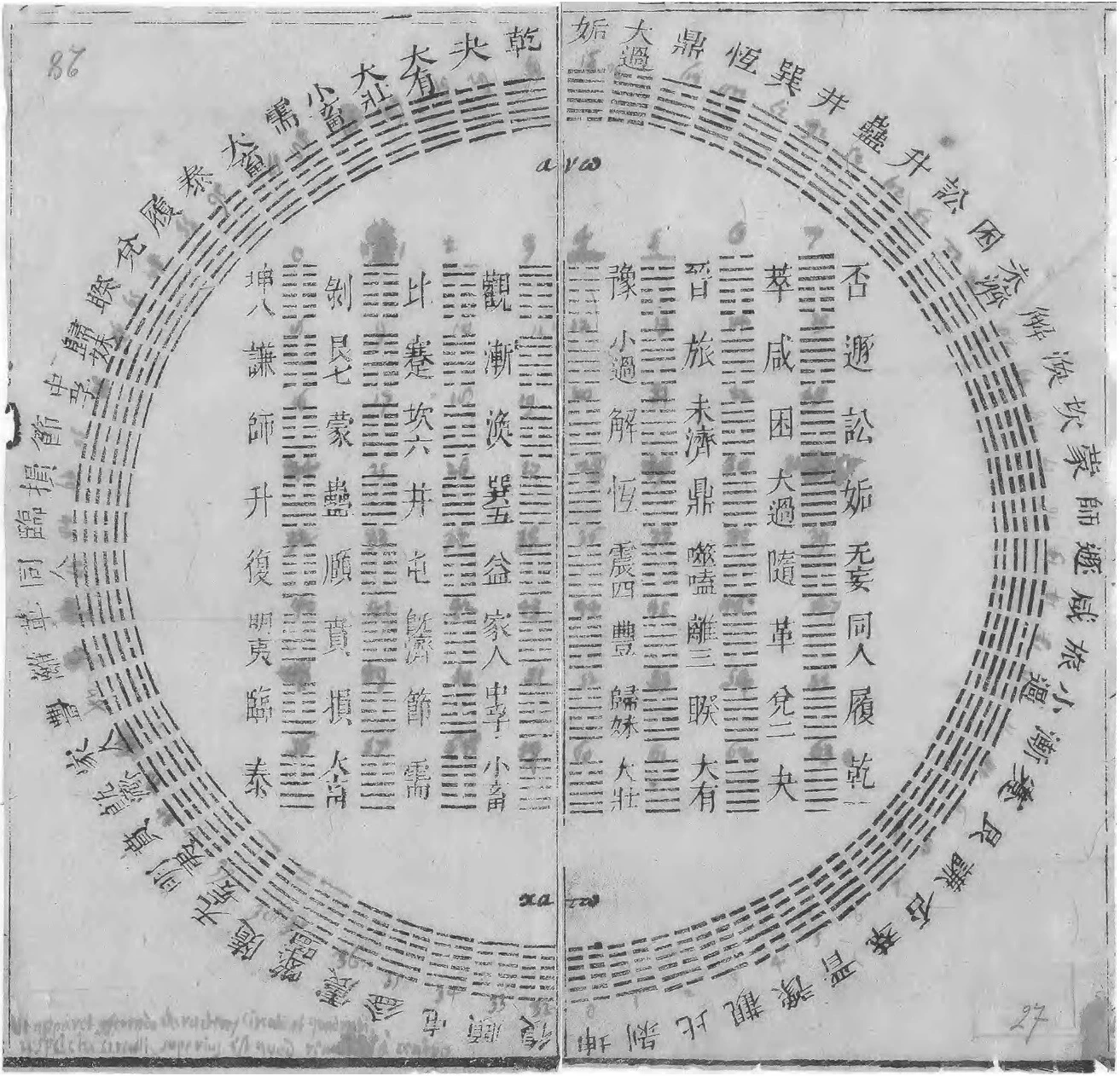
Shao Yong’s arrangement of the 64 hexagrams, sent to Leibniz from Beijing by Joachim Bouvet in 1701. Read broken lines as 0 and unbroken lines as 1, and the square counts from 0 to 63 in binary. Public domain. A cup of tea cools and never warms itself again. A footprint in wet sand holds its shape for a while, then fills in. Energy, information and life all depend on this one fact: the world runs one way. Without that asymmetry nothing could be stored, learned or used. So what is time? This essay follows the question until it runs out. It runs out in the same place every time, and the oldest book about change seems to have begun there.
Part oneWhat physics knows
Start with what is solid. In 1908 Hermann Minkowski told a meeting of scientists: “Henceforth space by itself, and time by itself, are doomed to fade away into mere shadows, and only a kind of union of the two will preserve an independent reality.” Relativity made the two a single fabric, spacetime, and how you cut it into space and time depends on how you are moving. This is not abstract. A clock on a GPS satellite gains about 38 microseconds a day on a clock on the ground, because of the satellite’s speed and its height. A blink lasts thousands of times longer. Still, the system has to correct for it, or positions would drift by kilometres a day.
Yet the time direction keeps rules that no direction in space has. You can walk back to where you were. You can’t walk back to when you were. Take two events. If a signal could travel from one to the other, every observer agrees which came first. If not even light could cover the distance in the time between them, observers can disagree about their order. The light cone draws that boundary, and it is the same for everyone.
The light cone. Everything inside the upper cone can be affected by what happens here; everything inside the lower cone could have affected it. Outside, “elsewhere”, no cause can connect to this point, and observers disagree about what happens before what. Then there is a stranger fact. The basic laws of physics work the same forwards and backwards. A film of two billiard balls colliding looks right played either way. A film of an egg breaking does not. The arrow we feel, eggs that break and don’t unbreak, memories of the past and none of the future, comes from somewhere else: the universe began in a state of very low entropy, and everything since has been running downhill from it. The philosopher David Albert called this the past hypothesis (2000). It explains the arrow. Nobody knows why it is true.
Now take the slope away and look at what is left. A universe at equilibrium, the heat death physicists expect at the very end, still obeys the same laws. But it has no gradients, so no work can be drawn from it, not even by the one-bit engine Leo Szilard imagined in 1929. It holds no records, because a record is a mark that hasn’t yet been smoothed away, and marks form only on a slope. And it has no direction: nothing comes before anything else in any way that matters. Directed time, usable energy and useful information disappear together. They look like one asymmetry seen from three sides. Where there is no slope, there is nothing to know and no one to know it.
Part twoThe timeless theories
Several serious theories go further. They say time is not fundamental at all.
- In the block universe, the picture many physicists take from relativity, past, present and future all exist together. Nothing flows. We are inside a four-dimensional shape, and “now” is only the place in it where we happen to be, as every frame of a film sits on the reel at once. Einstein seems to have believed this. When his friend Michele Besso died in 1955, he wrote to Besso’s family: “For us believing physicists the distinction between past, present, and future only has the meaning of an illusion, though a persistent one.” He died a month later.
- When Bryce DeWitt wrote down an equation for the quantum state of the whole universe (DeWitt, 1967), time dropped out of it. The universe taken as a whole does not change.
- Don Page and William Wootters then asked how anything happens at all (Page and Wootters, 1983). Their answer was to split the universe in two: a clock, and everything else. Each part on its own is static. But the two are correlated, and change is what the rest looks like when it is read against the clock. A tabletop experiment with entangled photons later showed a small version of this (Moreva et al., 2014).
- Julian Barbour (The End of Time, 1999) argues that the universe is a collection of “nows”, each complete in itself. Some of them he calls time capsules: arrangements so full of records that they look like a history, the way the layers in a cliff look like a story of floods. On this view a memory, or a fungus’s chemical map of the soil, isn’t a trace left by time. It is what gives the impression of time. Alain Connes and Carlo Rovelli proposed that the flow of time comes from incomplete information: a being that saw every detail would see no flow at all (Connes and Rovelli, 1994). If that is right, it closes a loop. Living things keep a compressed record of the past in order to predict the future. Here the compressing, the not seeing everything, may be what produces a past and a future in the first place.
The block universe, flattened to one dimension of space. Observers moving differently slice it into different “nows”. A life is a shape that runs through it, and the slope from low to high entropy gives that shape a direction. Look at how much survives in the block. Energy becomes gradients across its regions. Information becomes correlation: one region, the chemical map inside a hypha, matches another, the place where the sugar is. Prediction becomes correlation that points up the entropy slope. And life becomes a shape that holds itself together along that slope, like a whirlpool in a photograph: still on the paper, but there only because water was running through it. What all of this needed was never the flow of time. It was the slope.
These ideas don’t stand on equal ground. The block universe is mainstream. Page and Wootters is respected but debated. Barbour’s nows and thermal time are serious ideas that no one has yet tested.
The argument is much older than physics. Twenty-five centuries ago Parmenides argued that change is impossible and that reality is one, unchanging and timeless. Heraclitus answered that everything flows, and that no one steps into the same river twice. In 1908, the same year as Minkowski’s lecture, the philosopher J. M. E. McTaggart gave the debate its modern terms (The Unreality of Time). Time can be described as a flow, with events moving from future through present into past, or as a fixed order of earlier and later. The block universe keeps the order and drops the flow. The question is whether anything is lost.
Each of them relocates change instead of removing it. The block turns “first this, then that” into “here this, there that”, along one more axis. Page and Wootters put time inside a clock, and the clock still ticks. Barbour’s records still have to be read in order. Thermal time explains the flow by our ignorance, but an ignorance that unfolds how? Henri Bergson raised this objection in 1889 (Time and Free Will): physics draws time as a line, then forgets that the drawing isn’t the thing, the way a map of a river is dry. Lee Smolin raises it from inside physics in Time Reborn (2013). The block view answers that becoming is simply what it is like to be inside a slope. Bergson and Smolin answer that becoming is real and the geometry is a map of it. No experiment has settled it. That is why every timeless theory feels as if it is dodging something. It might be.
Part threeWhere the flow shows up
If physics keeps the order and drops the flow, the flow must come from somewhere. The nearest place to look is whoever is doing the perceiving. Here, for once, there are experiments and not only arguments.
The present is assembled. The “now” you experience isn’t an instant. William James called it the specious present (The Principles of Psychology, 1890): a short window that holds a few moments together, long enough to hear a melody rather than separate notes. Ernst Pöppel put the window at about three seconds (Pöppel, 1997). Inside that window the brain doesn’t only record; it edits. In the flash-lag effect, a flash shown level with a moving object seems to trail behind it, because the brain decides what happened at a moment using information from the following eighty milliseconds or so (Eagleman and Sejnowski, 2000). Your present is partly written after the fact, like a letter dated in the morning and finished at night.
Felt duration is a reconstruction. In one experiment, volunteers fell backwards 31 metres into a net. Afterwards they judged their own fall to have lasted about a third longer than other people’s. Strapped to each forearm was a small display flashing digits just too fast to read. During the fall the digits stayed unreadable. The fallers had not perceived more. They had remembered more densely (Stetson, Fiesta and Eagleman, 2007).
Different bodies, different nows. Smaller animals with faster metabolisms resolve finer slices of time. Many flies can see flicker several times faster than we can, which is part of why they are so hard to swat (Healy et al., 2013). The hand that seems quick to us arrives slowly to the fly. There is no single rate at which the present arrives.
None of this settles whether time flows. A brain that builds its present from a short, edited window would feel flow in a block universe, and it would feel the same in a world where becoming is real. But it moves the question. The flow we experience is at least partly made by the perceiver, from a compressed record stitched together slightly late. That fits the thermal-time idea above: a being that sees only part of the picture, and compresses it, is exactly the kind of being that feels time pass.
Part fourThe circle
So try to go underneath. Every definition of time leans on space, or on time itself. “Geometry” means extension across something. “Slope” means change along something. The attempts to build spacetime out of something more basic all meet the same wall:
- Causal sets start from points and an order: this precedes that. Rafael Sorkin’s slogan is “order plus number equals geometry”. But order is already time-like.
- Building space out of quantum entanglement (Van Raamsdonk, 2010) starts from correlations between parts. But “parts” already means a distinction: this, not that.
- Rewriting systems, like the Wolfram physics project, build space from networks of relations, but the rewriting goes in steps. Steps are time again.
What survives every attempt is two things: difference (this is not that) and relation (this connects to that). Put simply, space is relation without direction: A is next to B, and B is next to A. Time is relation with direction: A comes before B, and B does not come before A. That would make space and time neither one thing nor two, but the symmetric and the asymmetric form of the same relating.
This also tells us exactly how much survives without time. Gregory Bateson defined information as “a difference which makes a difference”. So there are three cases. With no distinctions at all, nothing holds: no information, no gradient, no life. With distinctions but no order, pattern and correlation survive (this part matches that part), but prediction, value and cost don’t, because each of them needs a before and an after. With distinctions and an asymmetry, everything works. That last case is the one physics actually supports.
But this only moves the circle back one step. “Difference” and “relation” can’t be defined without using them. Immanuel Kant thought this was unavoidable: space and time are the forms through which we think anything at all (Critique of Pure Reason, 1781), so we can’t think our way outside them, any more than an eye can see itself.
Part fiveWhere the old traditions start
Some traditions didn’t try to get underneath that floor. They began there.
The I Ching starts from change, not things. The Book of Change goes back, in its oldest layers, to around 1000 BC. Its unit is a single line, broken or unbroken: one difference, the smallest mark a brush can make. Six lines make a hexagram, and the 64 hexagrams are situations, each in the middle of turning into another. Things are passing states of change, not the other way round.
In 1701 the Jesuit Joachim Bouvet, writing from Beijing, sent Gottfried Leibniz a diagram of the hexagrams (the letter). Leibniz had already worked out binary arithmetic. Bouvet pointed out that if you read broken lines as 0 and unbroken lines as 1, the diagram counts from 0 to 63. The letter took seventeen months to arrive. Leibniz published his paper on binary in 1703, the year it reached him, and included the match. The bit and the Book of Change met three centuries ago, on paper that had crossed the world by ship.
0
000000
Kun1
000001
Bo2
000010
Bi3
000011
Guan…63
111111
QianBouvet’s reading: each hexagram, read from the bottom line up, is a six-digit binary number. Jain logic gives truth an address. Jain philosophers developed syādvāda, a logic of seven qualified claims: in some respect it is; in some respect it is not; in some respect it is and is not; in some respect it can’t be expressed; and combinations of these. Every truth is tied to a standpoint. “True and not true” is not a contradiction, because each holds from somewhere. The block universe does the same with places in spacetime. Physics doesn’t need real contradictions either. Quantum superposition is often described as something being true and not true at once, but that is a misreading: a superposed state has no definite value for that property, which is different from having both.
Nāgārjuna empties the floor. The second-century Buddhist philosopher Nāgārjuna argued that nothing exists in itself: everything exists only through its dependence on something else. He called this absence of own-being emptiness, śūnyatā. That is relation all the way down. Then he refused to make relation the new foundation: emptiness is empty too. In the Mūlamadhyamakakārikā he lists four answers to an ultimate question (it is, it is not, both, neither) and rejects all four. Not out of confusion, but because the question assumes a thing with fixed properties to ask about.
The Dao won’t be named. In Daoist cosmology the limitless, wuji, comes before the first split into yin and yang. The Dao De Jing opens: “The Dao that can be spoken is not the eternal Dao.” It says in one line what Kant needed a book for.
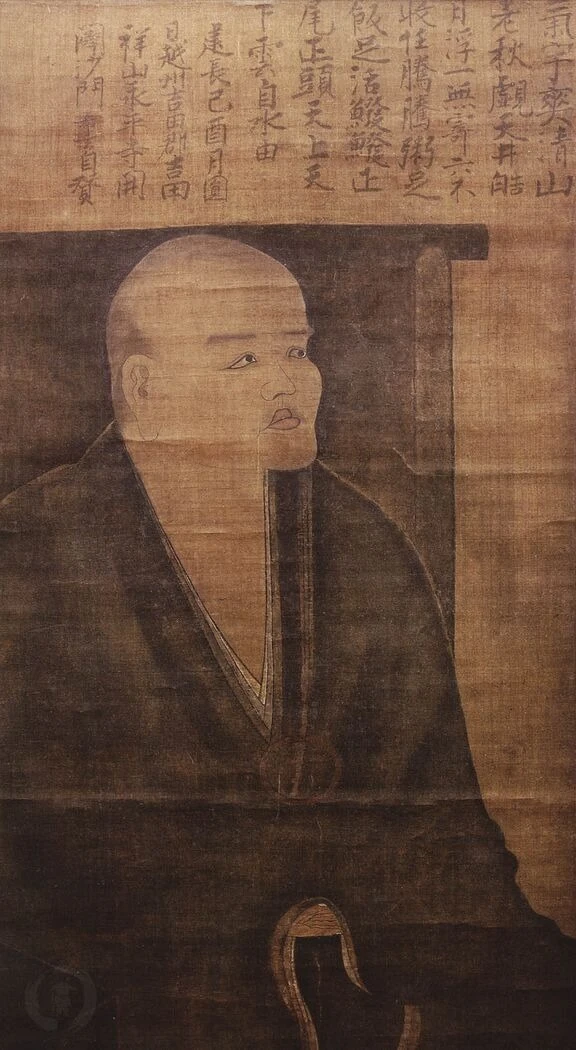
Dōgen watching the moon. 13th-century portrait, Hōkyō-ji. Public domain. Dōgen makes time and being one. The Japanese Zen master Dōgen wrote an essay in 1240 called Uji, usually translated as “Being-Time”, collected in the Shōbōgenzō. Its claim is that time isn’t a container things pass through: things are time, and time is things. Seven years earlier, in Genjōkōan, he gave an image that reads like the block universe written seven centuries early. Firewood burns to ash, and ash doesn’t turn back into firewood. But don’t think of the ash as after and the firewood as before, he says. Firewood stays in its own place as firewood, with its own before and after, and ash stays in its place as ash. Each moment is complete where it is, and the order still holds.
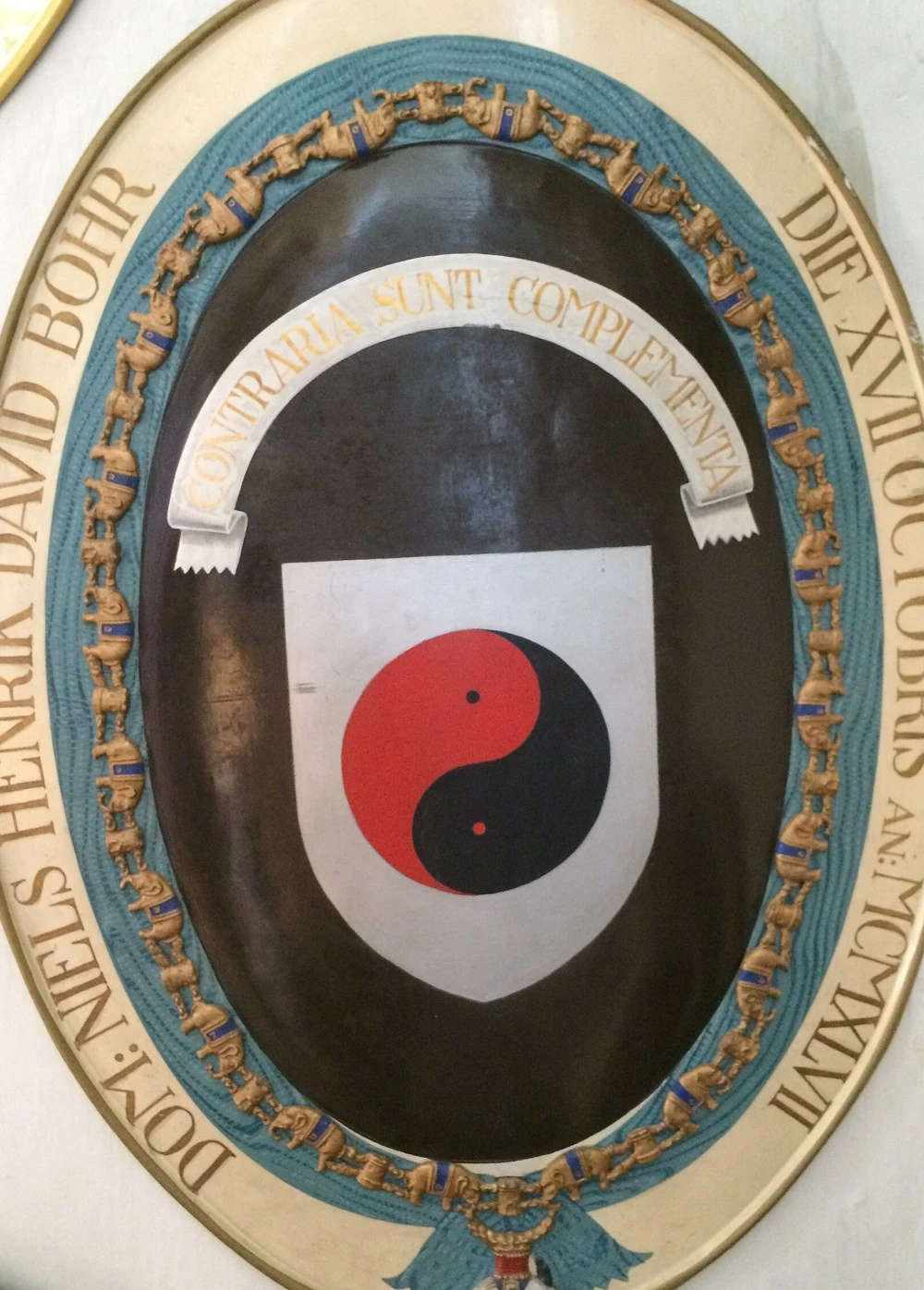
Niels Bohr’s coat of arms, 1947, in Frederiksborg Castle Church. Photo: Kim Bach, CC BY-SA 4.0. Physics has brushed against all of these. When Niels Bohr received the Order of the Elephant in 1947, he designed his coat of arms around the yin-yang symbol, with the motto contraria sunt complementa: opposites are complementary. It still hangs in a Danish castle church, among the painted shields of the order’s other knights. Carlo Rovelli’s relational reading of quantum mechanics says objects have properties only relative to other objects. In Helgoland (2020) he gives a chapter to Nāgārjuna.
These are parallels in structure, not evidence. Nobody in ancient China or India derived quantum theory, and the traditions don’t need physics to be taken seriously. What they share with the best modern thinking is a refusal to treat things as the bottom layer.
CodaBefore completion
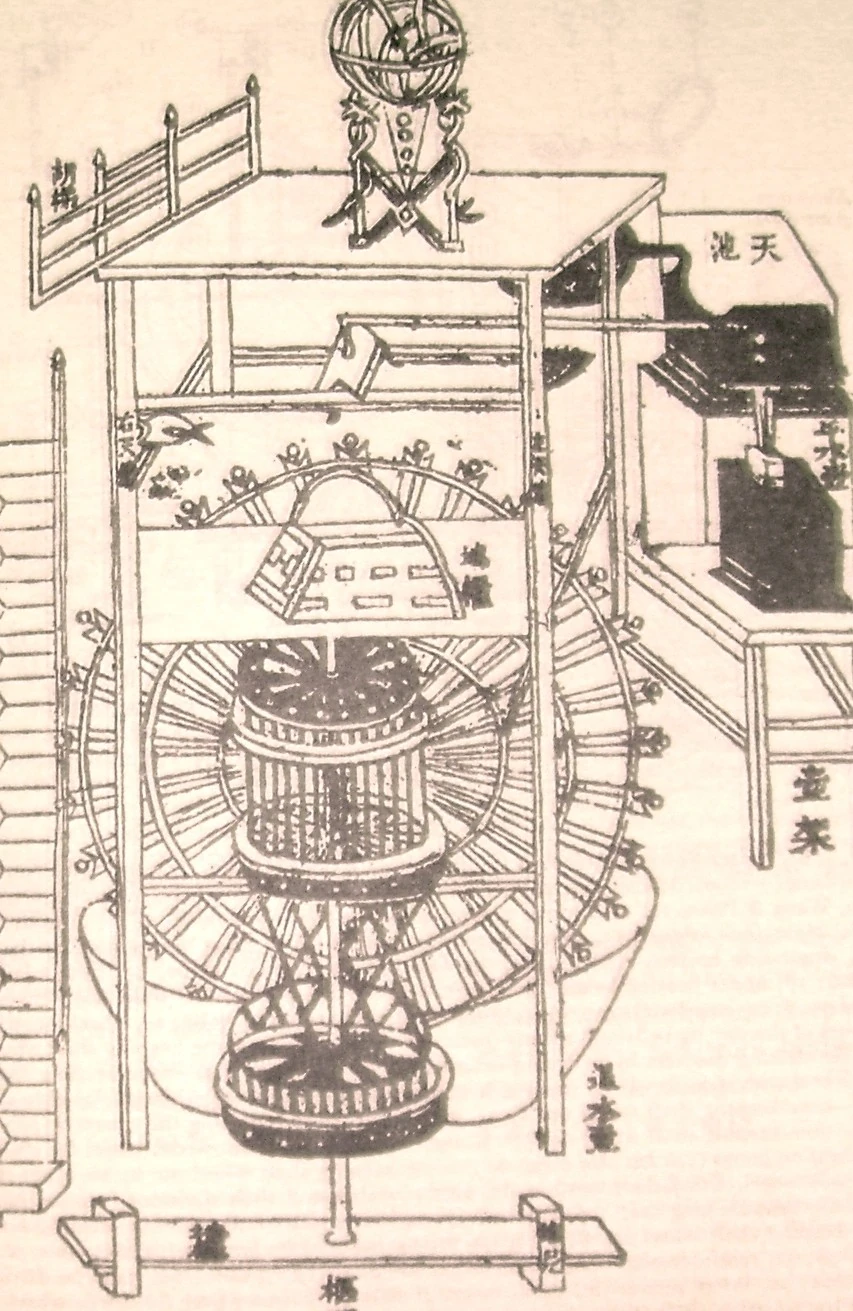
Su Song’s astronomical clock tower in Kaifeng, from his 1092 treatise. A water wheel turned an armillary sphere and struck the hours. Public domain. We measure time better than anything else. For a thousand years people have built ever better clocks, from Su Song’s water-driven clock tower in 11th-century China to today’s optical clocks, which run so evenly that they would drift by less than a second over the age of the universe. Su Song’s tower is long gone; the woodblock drawings of it survive. And we still can’t say what time is. Augustine put it this way around the year 400:
“What then is time? If no one asks me, I know; if I wish to explain it to one who asks, I know not.”Augustine, Confessions, Book XI
That isn’t a gap the next theory will close. Every attempt runs into the same place: difference and relation, which can’t be defined without themselves. Physics relocates change, into a dimension, a clock or our ignorance. The older traditions treat the limit as the finding. The I Ching makes it motion, the Jains make it perspective, Nāgārjuna says the floor is empty, Dōgen says time and being are one, and the Dao says it can’t be named.
The Book of Change doesn’t end on an answer either. Its 63rd hexagram is called After Completion. The 64th, the last, is Before Completion.
“Things cannot be exhausted; therefore the sequence closes with Before Completion.”
物不可窮也,故受之以未濟終焉 — Xugua, the traditional commentary on the order of the hexagrams
-
The East German spymaster Markus Wolf
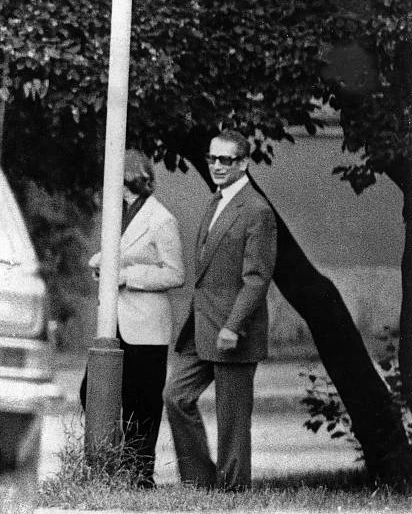
The East German spymaster Markus Wolf was known as the “man without a face” until this photograph was taken in Stockholm, Sweden in 1978.
Wolf came from an ardently communist German family who sought asylum from Hitler in Moscow in 1934. The young Wolf soon attracted the attention of Stalin's regime as a boy with great potential. In 1945, he arrived back in a divided Berlin on just the second plane to land from Moscow after the fall of Nazi Germany. In 1951 joined the Stasi and began a stratospheric rise to the top of its foreign intelligence wing, known as the HVA, reaching the rank of Lieutenant General.
Over the course of his career, he ran a network estimated to comprise more than 20,000 agents: one of the largest in history. He pioneered new strategies including employing "Romeo" agents to target vulnerable West German women, in a sort of reverse honeytrap. One of the greatest successes of this program was the recruitment of Gabriele Gast, a postdoc student in 1968 who eventually rose to a senior position within the Soviet section of West Germany's BND intelligence service. She worked as a double agent for nearly 20 years until the fall of the Berlin Wall and the reunification of Germany.
Wolf was known to be a debonair, charming man from a bourgeois background who was a master manipulator. He focused on human intelligence rather than technical collection means. Another of his greatest successes was running a senior BND counterintelligence official named Klaus Kuron beginning in 1981. Wolf effectively directing West Germany's own counterintelligence operations against himself for nearly a decade.
In 1978, the Swedish SAPO intelligence agency took this photograph of him while on a trip to Stockholm with his wife. A Stasi defector named Werner Stiller positively identified him. Wolf finally had a face, 26 years after he joined the Stasi.
Following German reunification, Wolf was briefly imprisoned but his conviction was soon overturned. He then came out into the open and even published an autobiography.
-
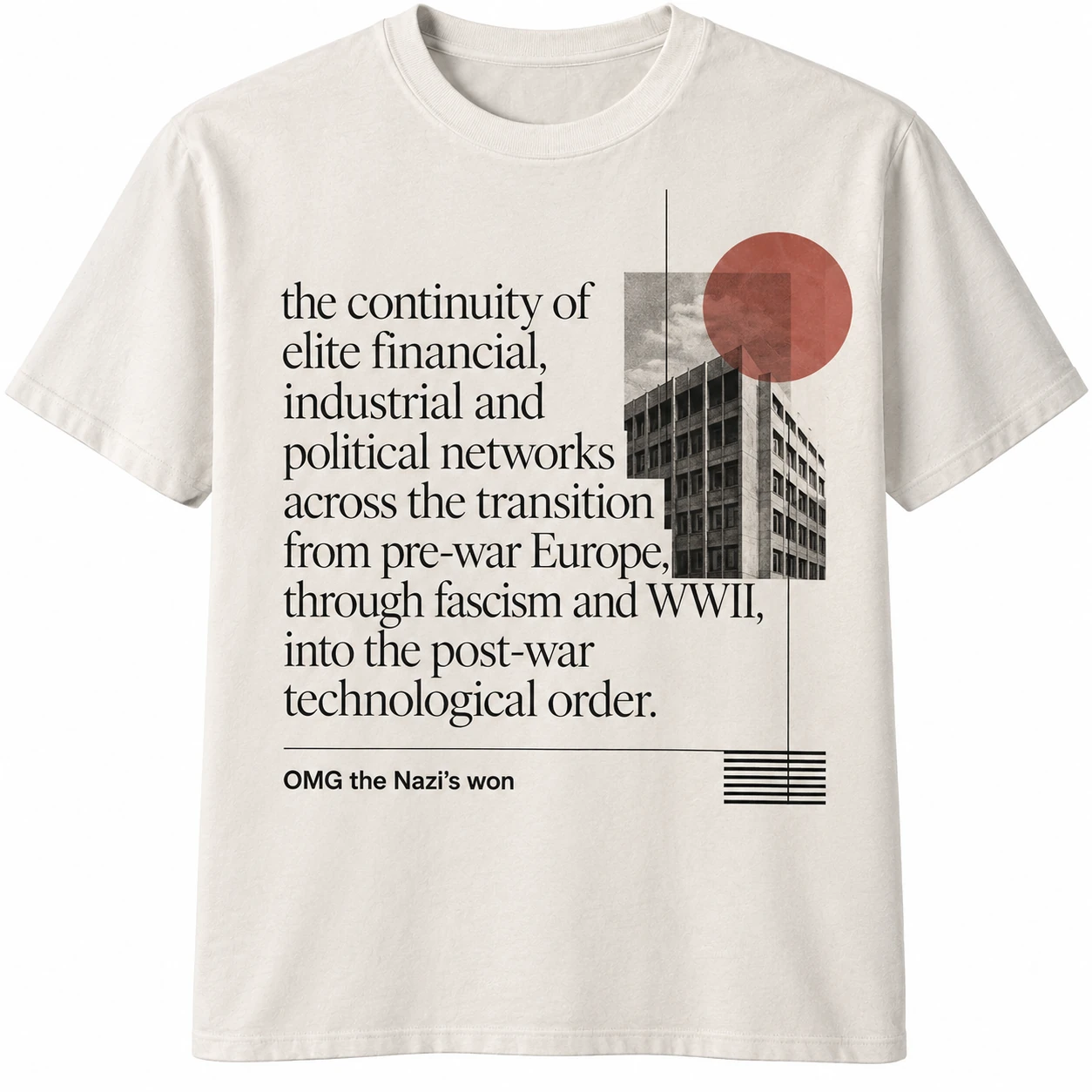
Having fun with my new Realpolitik T-Shirt series
"the continuity of elite financial, industrial and political networks across the transition from pre-war Europe, through fascism and WWII, into the post-war technological order. OMG the Nazi's won"
-
The west in 2026
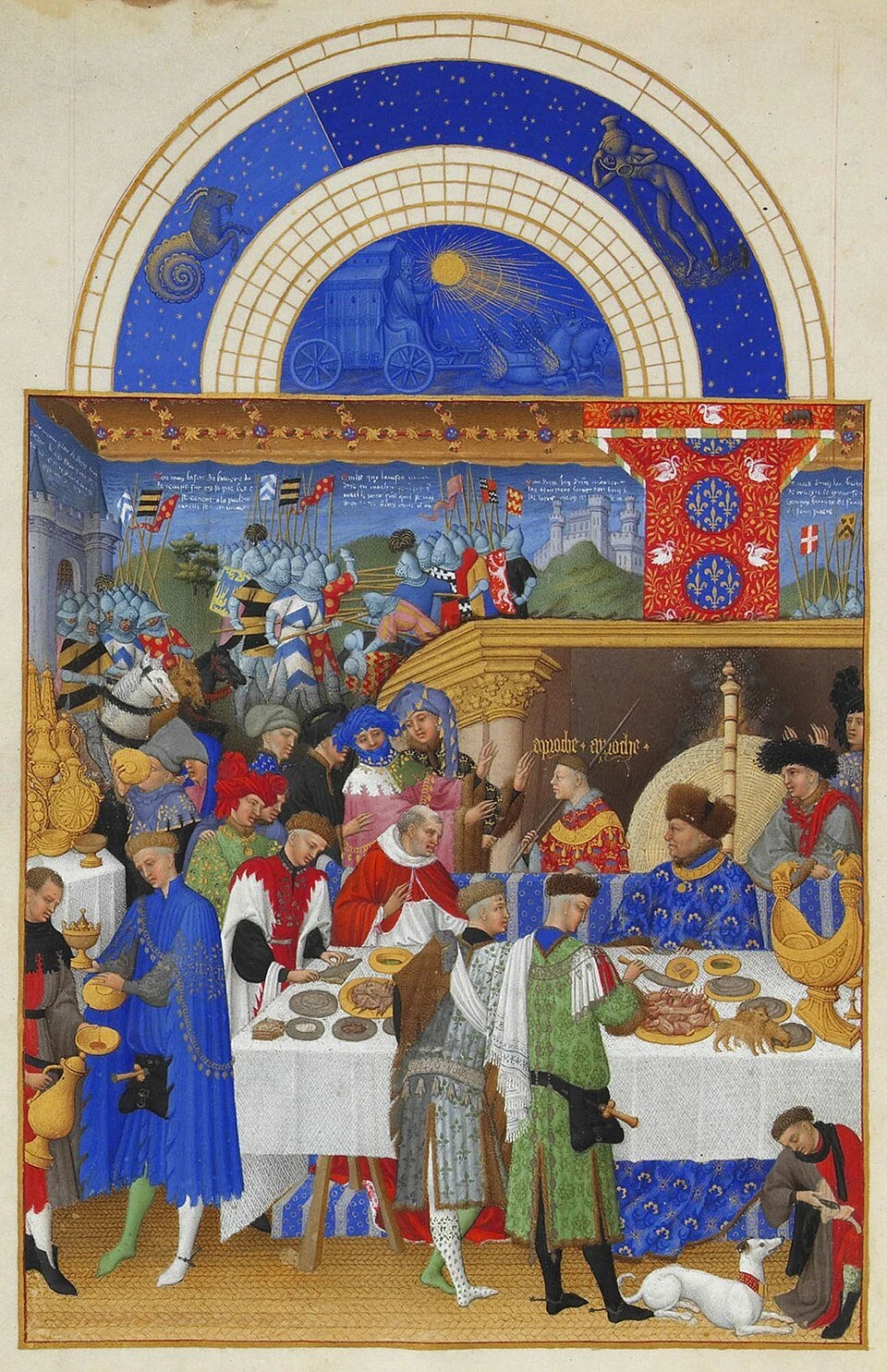
a medieval king's court
written by telenovela writers
produced as a military-grade psyop
streamed to a society of fruit flies
this week's episode: the AI emperor abdicates.next week on the court:
the treasurer reads the royal accounts aloud.
the king’s heir from the rival house declines to comment.
the jesters price it all in.
the flies have forgotten who the emperor was. -
The Demiurge & the Crooked Tree
Around 360 BC Plato described a god who builds the world with geometry. This is how that idea travelled through cathedrals, lodges and laboratories into today's AI labs, and what a tree that nobody built has to say about it.
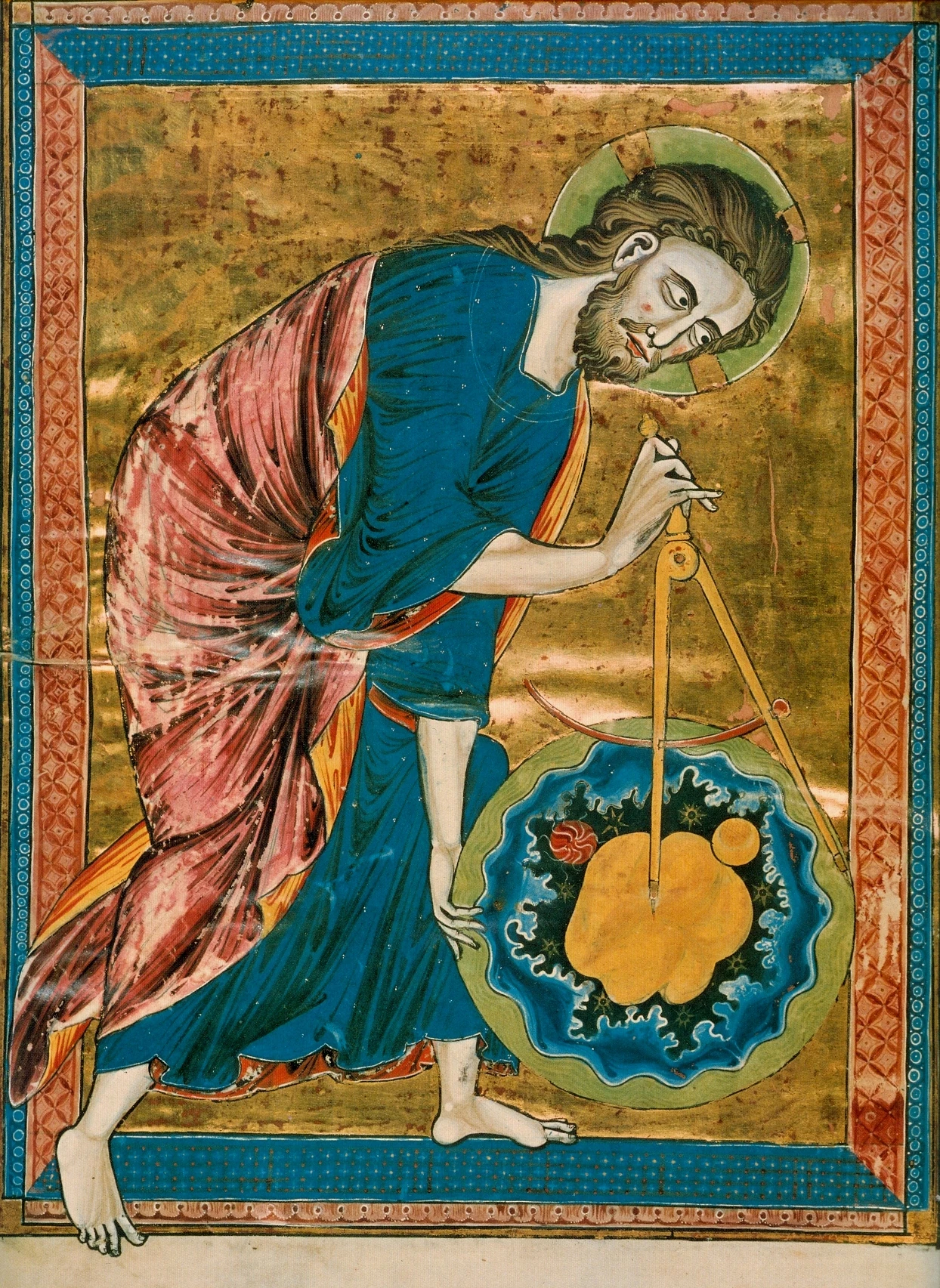
God as architect of the universe. Bible moralisée, France, c. 1220s. Vienna, ÖNB Cod. 2554. Few people today have read Plato's Timaeus, yet few books have shaped Western thought as much. The philosopher Alfred North Whitehead said that European philosophy is "a series of footnotes to Plato". Many of those footnotes lead back to this one dialogue.
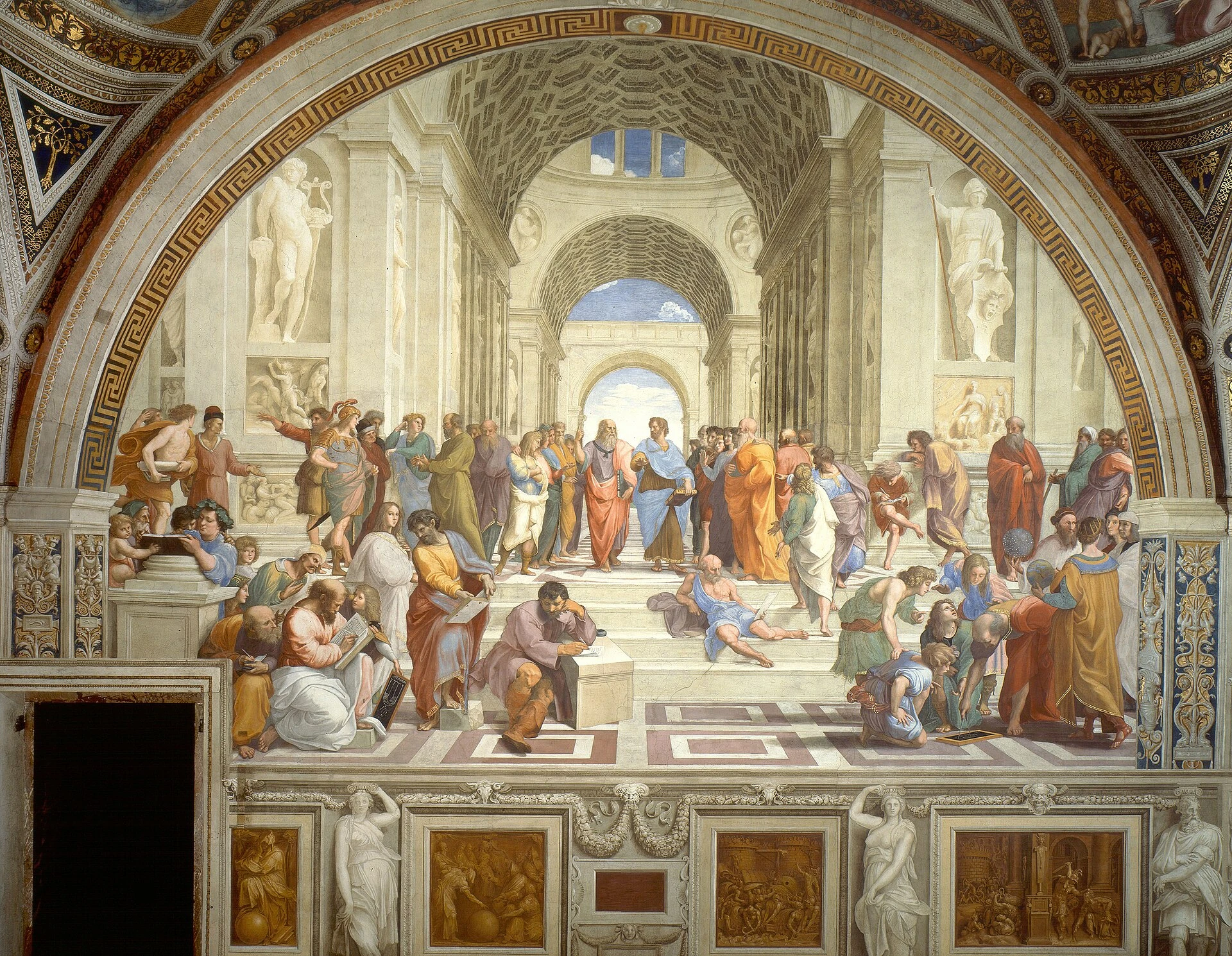
When Raphael painted The School of Athens in the Vatican, he placed Plato at the centre with a book under his arm. It is not the Republic. It is the Timaeus. Plato points upward, toward the eternal. Beside him, Aristotle holds his hand flat, palm down, toward the earth. The two gestures sum up two ways of looking for order: above the world, or inside it.
 TIMEO · ETICA
Raphael, The School of Athens, 1509–11. As the picture zooms in, the titles become readable: TIMEO for Plato, ETICA for Aristotle. Public domain. For about seven centuries, for most readers in Latin Europe, the Timaeus simply was Plato. In the 4th century a scholar named Calcidius translated its first half into Latin and added a long commentary, and the cathedral schools of the Middle Ages grew up on that translation. It is often said that Plato was lost to the West until the Renaissance. This is not quite true. The Timaeus was the part of Plato that stayed.
The same dialogue is also where the story of Atlantis first appears. We will meet it again later.
I should say at the start where this essay is going. The creation story in the Timaeus can be laid next to the way today's AI labs describe their work, and the two match closely, step by step. If you are short of time, you can go straight to that comparison. But the history explains why the match exists, so I recommend the longer road.
α΄A likely story
The dialogue takes place the day after Socrates has described his ideal city. He says he would like to see such a city in action. Critias offers the tale of Atlantis, which he says reached Athens from Egyptian priests through the statesman Solon. Then Timaeus, an astronomer from Locri in southern Italy, takes over. In one long speech he describes the whole universe from its beginning: the gods, the stars, the elements, the soul, and even the bone marrow, the liver and disease.
Before he begins, he warns his listeners. What he is about to tell, he says, is an eikōs muthos (εἰκὼς μῦθος), a likely story. Eternal things can be known exactly. The things we see and touch, which are always changing, can only be described in a way that is probable. So Timaeus offers the best account he can, and no more.
This warning matters, and I will come back to it, because most of Plato's later readers forgot it.
The universe of the Timaeus rests on three principles:
ΝοῦςIntellect · The DemiurgeA divine craftsman. He does not create from nothing. He finds matter "in discordant and disorderly motion" and puts it in order, because he is good and wants everything to be as good as possible. His model is the eternal Forms.
ἈνάγκηNecessity · The ReceptacleThe chōra: a neutral space in which things appear and dissolve, "the nurse of all becoming". Plato admits we can grasp it only "by a kind of bastard reasoning", as if in a dream.
ΨυχήThe World SoulThe cosmos is a single living creature with a body and a soul. The soul is mixed from Being, Sameness and Difference, and it is what makes the heavens turn in regular circles.
Time comes from this as well. Plato calls it "a moving image of eternity": the steady turning of the heavens is a moving copy of something that does not move.
There is one more detail, and later readers usually skipped it. Matter resists. Plato calls this resistance Necessity, or the "wandering cause". The craftsman does not defeat Necessity. He persuades her:
Reason overruled Necessity by persuading her to guide the greater part of the things that come to be toward what is best.Timaeus 48a
Note the words "the greater part". Not everything. Plato left a margin in his cosmos where the craftsman does not get his way. Most of the traditions that followed him quietly removed it.
β΄Fire is made of pyramids
Then Plato does something remarkable for the 4th century BC. He proposes a theory of atoms. His atoms are not small balls, as they were for Democritus. They are triangles.
There are two kinds: half of an equilateral triangle (angles of 30°, 60° and 90°) and half of a square (45°, 45° and 90°). Triangles combine into faces, faces into solids, and each solid is an element. Fire is the pyramid, the tetrahedron, which is why, Plato says, fire feels sharp: it cuts. Choose an element below, drag it to turn it, and show the atoms to see its triangles.
Open the post page for the interactive Platonic solids.
The system has a curious property. When fire cuts a particle of water, the water breaks into one particle of fire and two of air. Water has twenty triangular faces, fire has four and each air has eight, so twenty faces go in and twenty come out. The triangles are conserved. More than two thousand years before physicists wrote down the conservation of energy, Plato wrote down a conservation law for triangles.
Earth is the exception. Its cube is built from the other kind of triangle, so it cannot trade with the rest. It breaks apart, drifts, and comes back together, but always as earth.
There are five regular solids and only four elements. The fifth, the dodecahedron, gets a single mysterious sentence: the god used it "for the whole, embroidering it with figures". It cannot be built from Plato's triangles at all. The one shape that does not fit the system becomes the shape of heaven.
These ideas lasted a long time. In the spring of 1919, during the street fighting in Munich, the seventeen-year-old Werner Heisenberg was posted on the roof of a seminary, and in the quiet mornings he read the Timaeus in Greek. He thought the triangle atoms were absurd. But he could not let go of the idea that the smallest parts of matter might be mathematical forms rather than tiny objects. Many years later he wrote that modern physics had "definitely decided in favor of Plato".
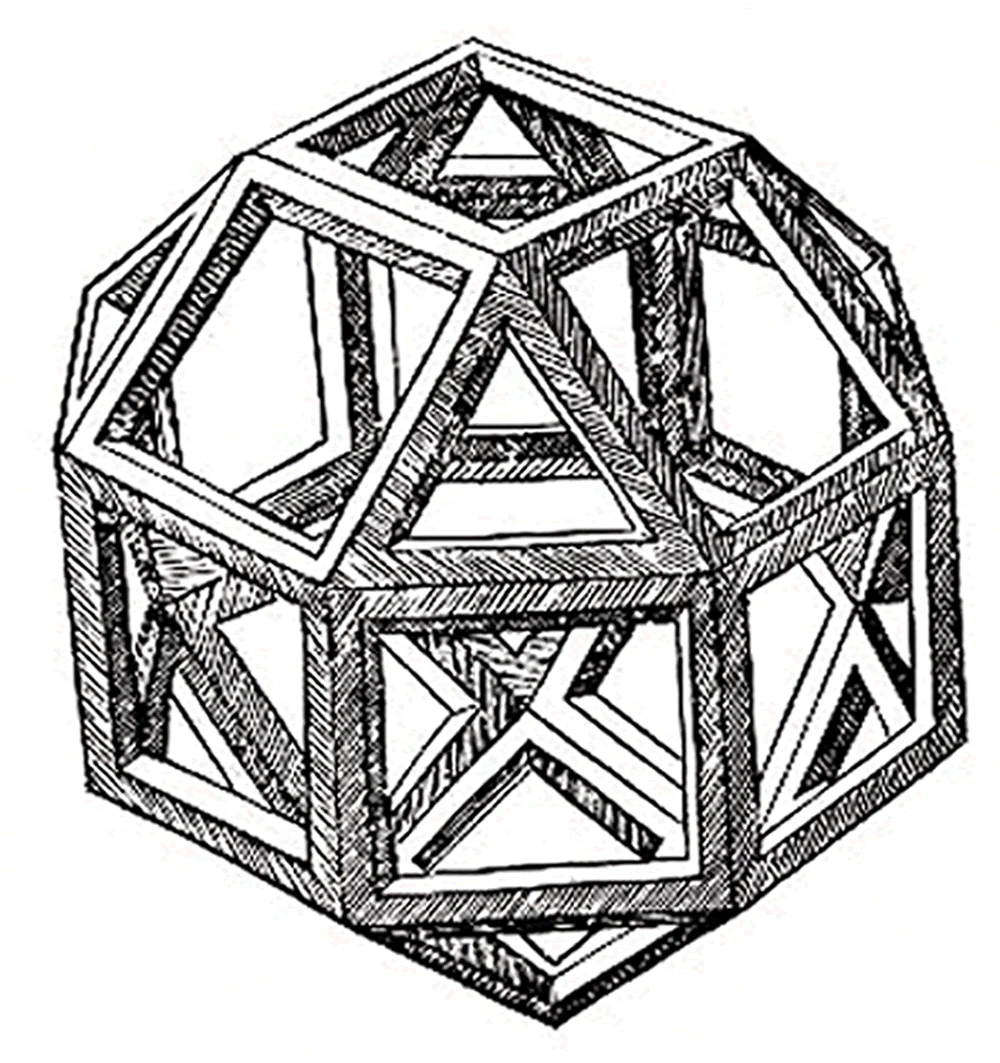
Leonardo da Vinci's drawings of the solids for Luca Pacioli's De divina proportione, 1509. 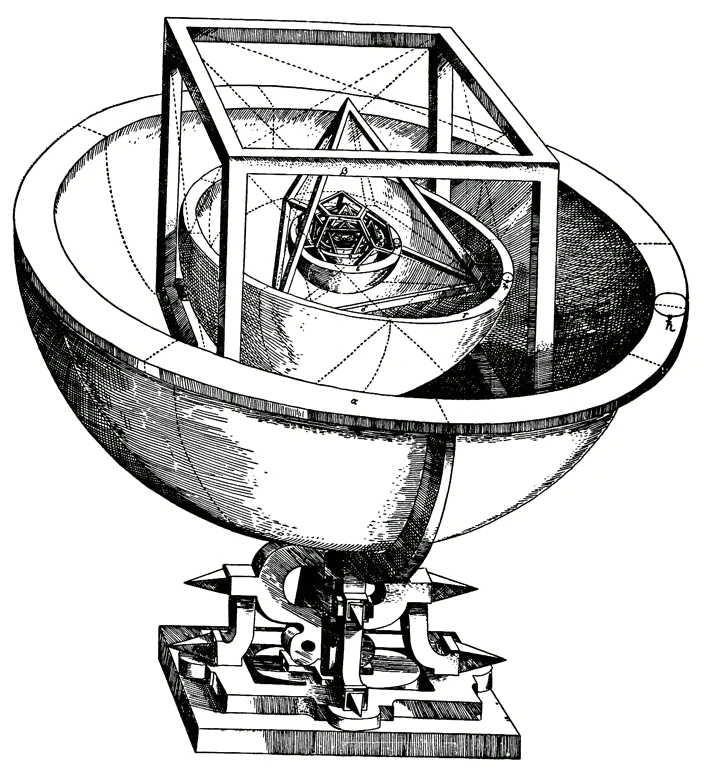
Johannes Kepler, Mysterium Cosmographicum, 1596. The five solids nested inside one another, one between each pair of planetary spheres. In 1596 Johannes Kepler, then twenty-four, took the solids literally. He placed them one inside another and claimed they explained the distances between the six planets known at the time. It was a beautiful idea, and it was wrong.
What I admire is that Kepler himself gave it up. Years later, working with Tycho Brahe's precise observations of Mars, he found that the orbit would not fit a circle, however he tried. The orbits were ellipses. He abandoned his most beautiful idea because the measurements would not agree with it. For once, Necessity persuaded the craftsman.
γ΄The soul is a tuned instrument
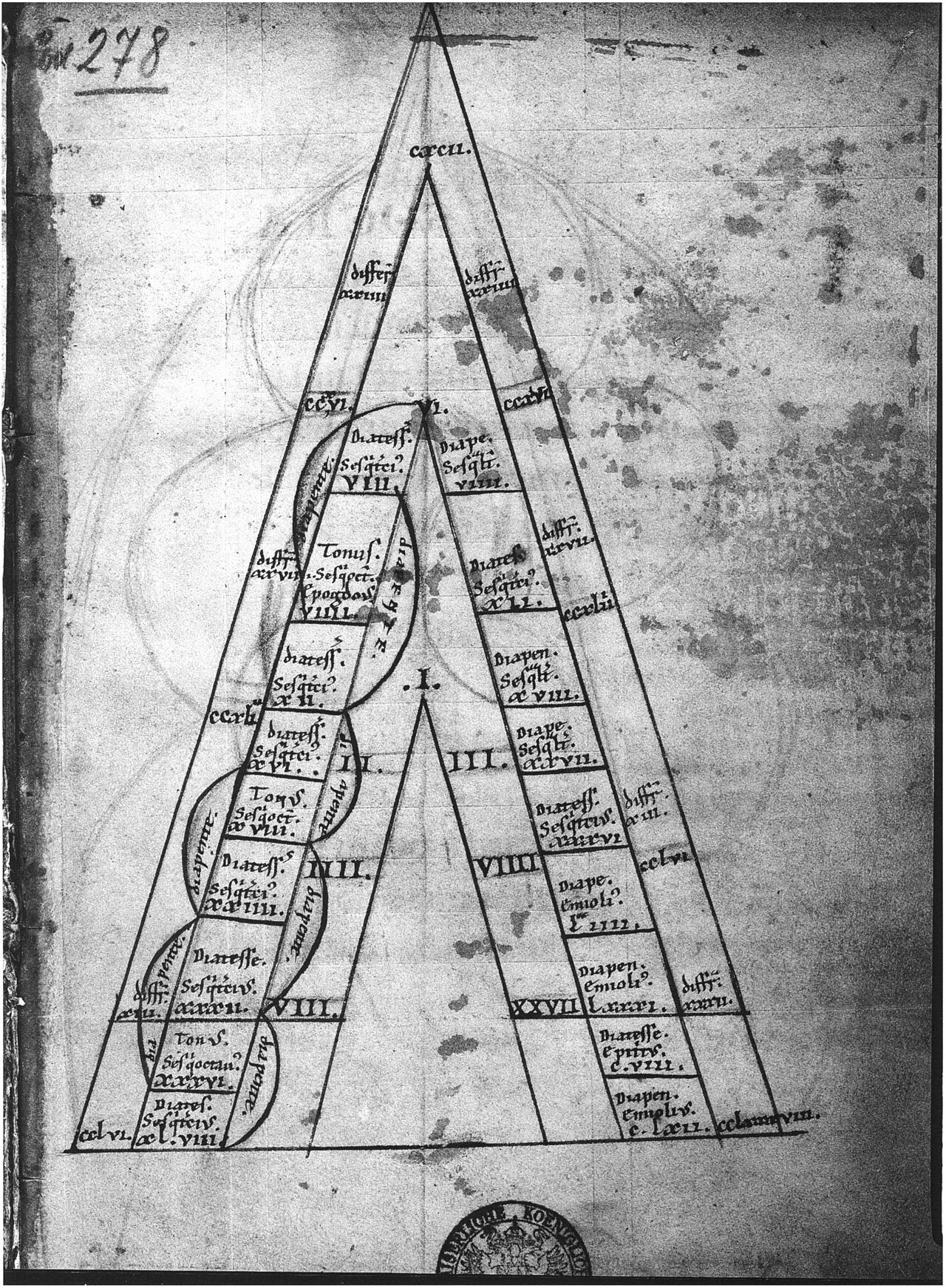
The numbers of the World Soul drawn as a large Λ and filled with musical ratios. Calcidius manuscript, Vienna ÖNB 278. The cosmos needs a soul, so the craftsman mixes one in a bowl, from Being, Sameness and Difference. Then he divides the mixture according to numbers.
He measures out portions in the proportions 1, 2, 3, 4, 9, 8, 27. These are two series: the doubles 1, 2, 4, 8 and the triples 1, 3, 9, 27. Medieval copyists drew them in the shape of the Greek letter lambda, Λ. Then he fills the gaps between the numbers until every interval is a tone of 9:8, with a small remainder of 256:243.
The result is the Pythagorean musical scale. The soul of the universe, in other words, is tuned like an instrument. Tap the numbers to hear them.
Next the craftsman cuts this strip of soul in two along its length, lays the halves across each other in the form of an X, and bends each into a circle. The outer circle, the circle of the Same, carries the fixed stars, which all turn together. The inner circle, the circle of the Different, is divided into seven rings for the planets, which move at their own speeds. The universe becomes a set of turning rings governed by musical ratios.
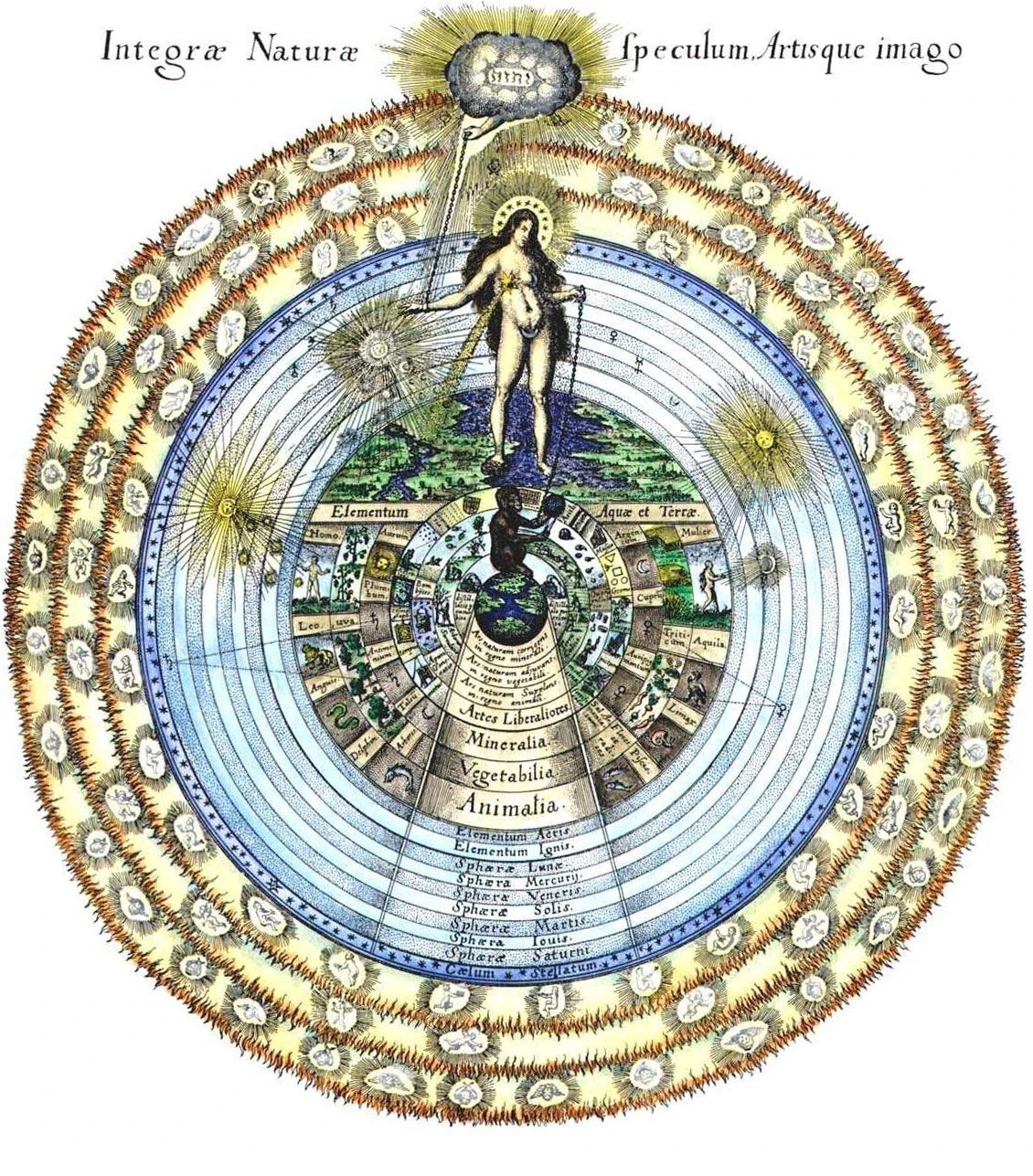
Robert Fludd, Utriusque Cosmi Historia, 1617. The World Soul as a woman chained to God above and to an ape below, the ape standing for human art, which imitates nature. Each human being also receives a soul, mixed from what was left in the same bowl and less pure. When this soul is placed in a body, the rush of sensation throws its circles into disorder. A newborn child, Plato says, is like a man standing on his head.
Life therefore has a task: to put the circles back in order. The method is to look up. We were given eyes, Plato says, so that we could watch the regular motions of the heavens and use them to correct the irregular motions of our own minds. One could call it salvation through astronomy.
The arrangement is simple. The cosmos is a perfect mechanism, each of us is an imperfect copy, and by studying the mechanism we can be repaired. This is the idea that travels furthest in the rest of the story.
δ΄God picks up a compass
From here on, the idea leaves the book.
Around 1220, in Paris, an illuminator painted God bending over a lumpy ball of chaos and measuring it with a pair of compasses. The picture states the idea in one image: God is an architect. It also suggests the reverse, though nobody said so aloud: an architect is a little like God.
The Renaissance gave the idea new force. In 1484 Marsilio Ficino, paid by the Medici, published the first complete Latin translation of Plato. Luca Pacioli wrote about the divine proportion, Leonardo drew the solids, Kepler nested them, and Robert Fludd engraved the cosmos as a single string tuned by a hand reaching out of a cloud. God was now a geometer, and the geometer was a kind of hero.
Kepler against Fludd
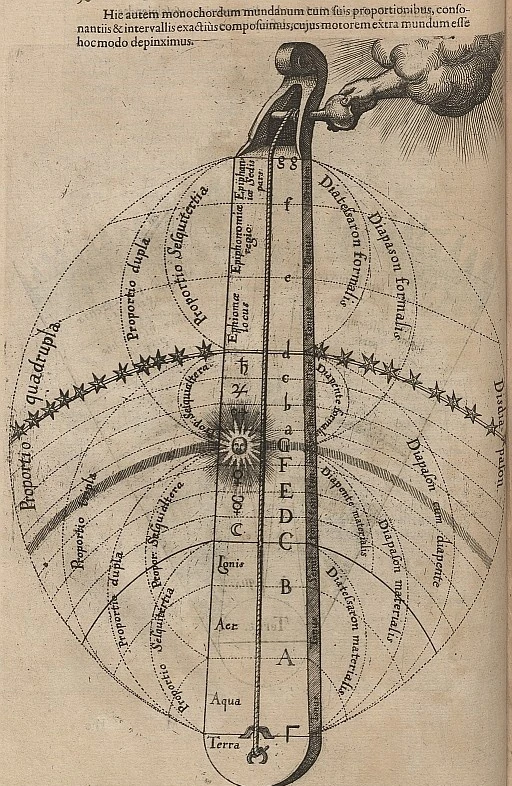
Fludd's divine monochord, Utriusque Cosmi Historia, 1617. One string from the earth to the highest heaven, tuned by a hand from the clouds. Two of these men then quarrelled. In 1619 Kepler published Harmonices Mundi, The Harmony of the World, with an appendix attacking Fludd. Fludd replied, Kepler replied again, and the exchange of pamphlets went on for three years.
Both believed the cosmos was built on harmony. They disagreed about how a person could know it. For Kepler, harmony was something to be measured: real ratios in real orbits, checked against Tycho's numbers. For Fludd, mathematicians dealt only in "quantitative shadows", and true harmony was known from within, through a sympathy between the soul and the world. Kepler's answer became famous:
I have the tail in my hand, but you may be grasping the head mentally, though, I fear, only in your dreams.Kepler to Fludd, 1622, as quoted by Wolfgang Pauli
This is the same disagreement that runs through this essay, between order imposed from outside and order found within, but here it happens inside the West, between two men who both used compasses. Kepler won, and modern astronomy grew from his method. Three centuries later Wolfgang Pauli, one of the founders of quantum mechanics, wrote a long study of the quarrel and ended with some sympathy for Fludd. Science, he felt, had won by leaving out half of the question.
New Atlantis
Francis Bacon died in 1626, the story goes, of a chill he caught while stuffing a chicken with snow to see whether the cold would preserve the meat. He left an unfinished utopia whose title answers Plato directly: New Atlantis.
Plato's Atlantis was a warning: a rich, clever and arrogant empire beyond the Pillars of Hercules, which the gods sank "in a single day and night". Bacon's island, Bensalem, lies hidden in the Pacific, and it is governed, discreetly, by a research institute.
The institute is called Salomon's House. Its members carry out experiments in deep caves and high towers, breed new plants and animals, and build engines, lenses and "sound-houses". They send secret agents, the "Merchants of Light", abroad to collect the knowledge of other countries. They also decide among themselves which discoveries the state will be told about. Their purpose is stated like this:
The End of our Foundation is the knowledge of Causes, and secret motions of things; and the enlarging of the bounds of Human Empire, to the effecting of all things possible.Francis Bacon, New Atlantis, 1627
It is hard to read this today without thinking of the mission statement of an AI lab.
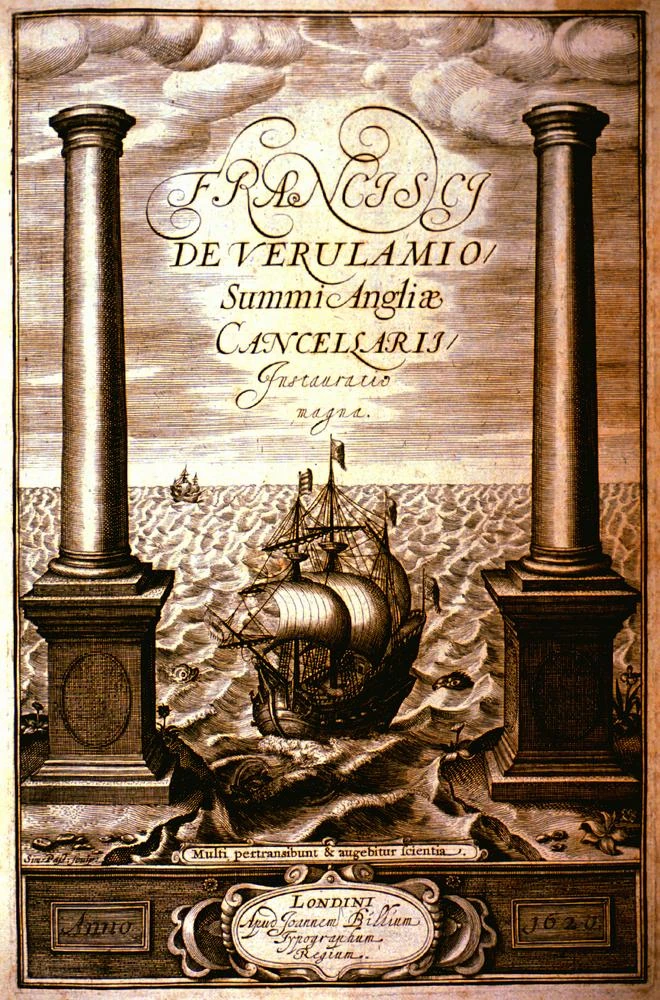
Frontispiece of Bacon's Instauratio Magna, 1620. A ship sails out between the Pillars of Hercules, where Plato placed Atlantis. The motto reads: "Many will pass through, and knowledge will increase." 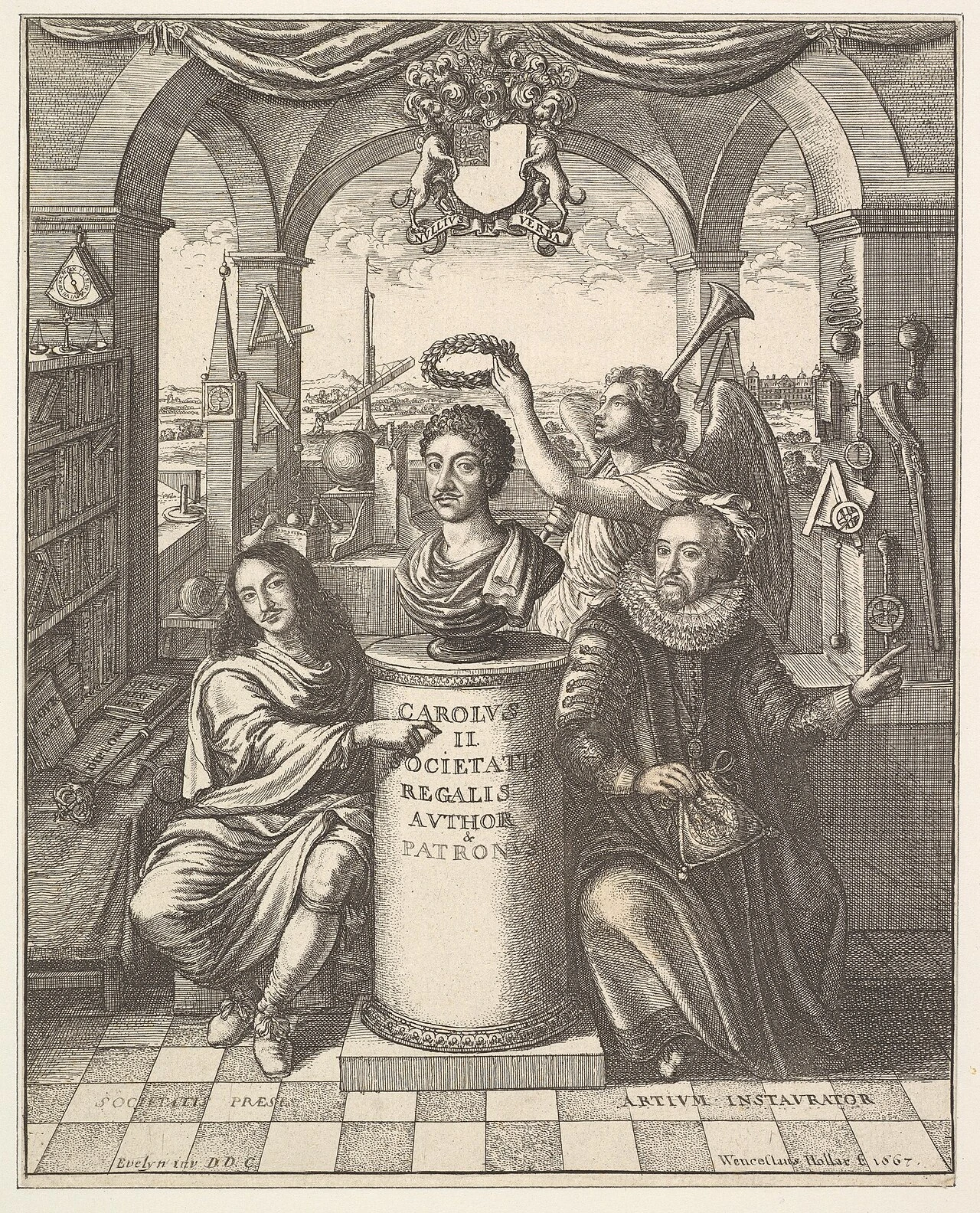
Wenceslaus Hollar's frontispiece to Sprat's History of the Royal Society, 1667. Bacon sits on the right, named Artium Instaurator, the renewer of the arts, among scientific instruments. Bacon also wrote the clearest version of Plato's idea of persuasion: "Nature, to be commanded, must be obeyed." Both halves are in the sentence. The centuries that followed mostly remembered the first.
Salomon's House became the ideal of English gentlemen who experimented in their spare time. The founders of the Royal Society treated Bacon as their patron and his imaginary institute as their plan. The Freemasons, whose rituals centre on Solomon's Temple, drew from the same source. Historians still argue about how much of this resemblance is influence and how much is coincidence.
The Freemasons
In the same decades, the idea found an organisation.
- 1598The Schaw Statutes regulate the Scottish lodges of working stonemasons, men who actually cut stone.
- 1646Elias Ashmole, antiquarian, astrologer and alchemist, is made a Freemason in Warrington. He has never cut a stone in his life.
- 1660The Royal Society is founded, with Salomon's House as its ideal. Ashmole is one of its early fellows. The two worlds share the same rooms and many of the same people.
- 1717Four London lodges meet at the Goose and Gridiron tavern near St Paul's and form a Grand Lodge.
- 1723James Anderson publishes the Constitutions of the Free-Masons, which begins:
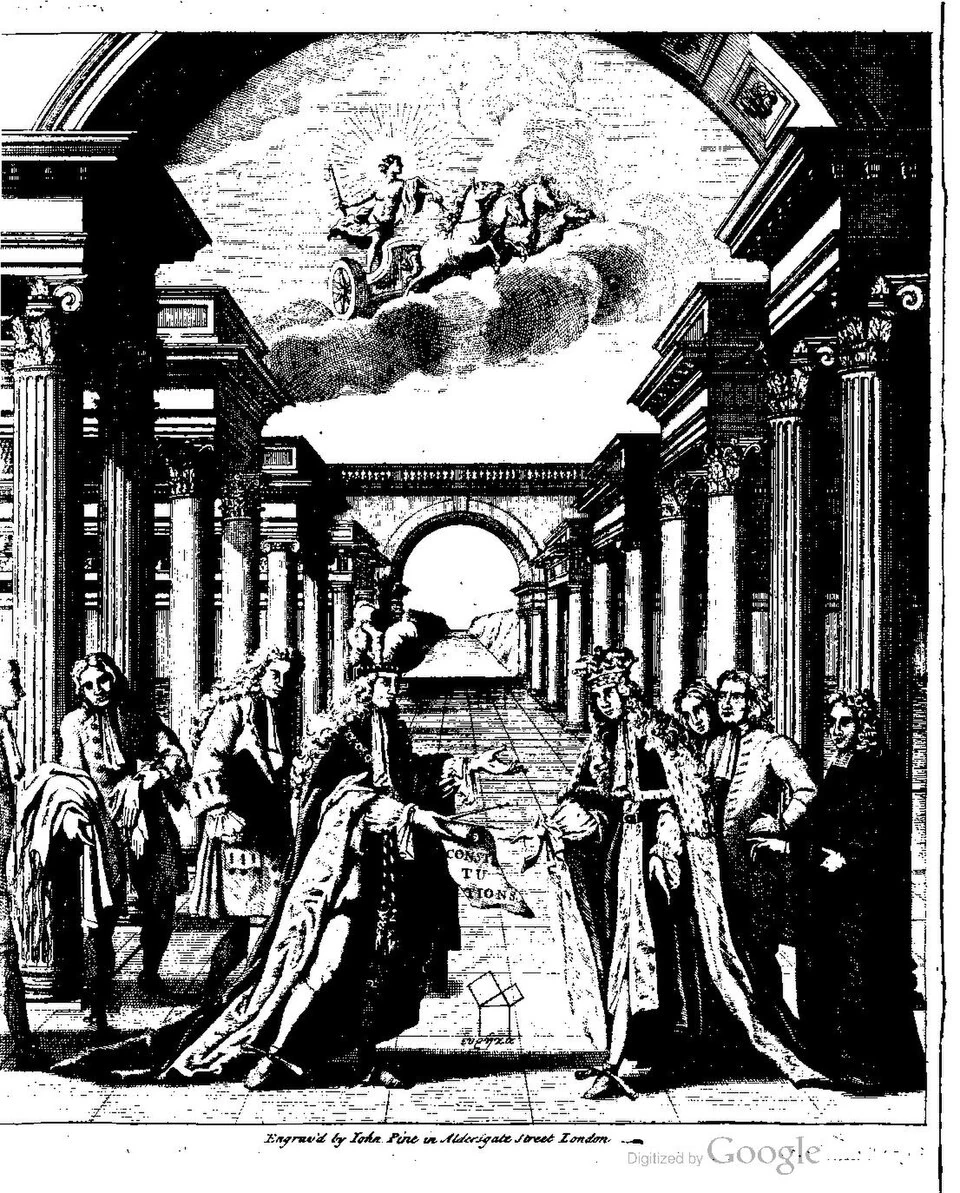
Frontispiece of Anderson's Constitutions, 1723. On the floor lies a diagram from Euclid. Adam, our first Parent, created after the Image of God, the great Architect of the Universe, must have had the Liberal Sciences, particularly Geometry, written on his Heart.Anderson's Constitutions, 1723
Geometry, written on the human heart by an architect. These new "speculative" masons had taken over a guild of men who really built things. They kept the tools, the square, the compasses and the plumb line, but applied them to the self. The rough stone stood for the unformed person, the smooth, squared stone for the person improved. It is the pattern of the Timaeus again: the order of the cosmos used to correct the disorder of the individual.
In the lodges, members were taught with painted "tracing boards" laid on the floor. They show two pillars, a ladder to heaven, the square and compasses, the all-seeing eye, and often Euclid's 47th proposition, the theorem of Pythagoras, as the emblem of the whole enterprise: a god who builds with geometry, and men who become more like him by learning it.
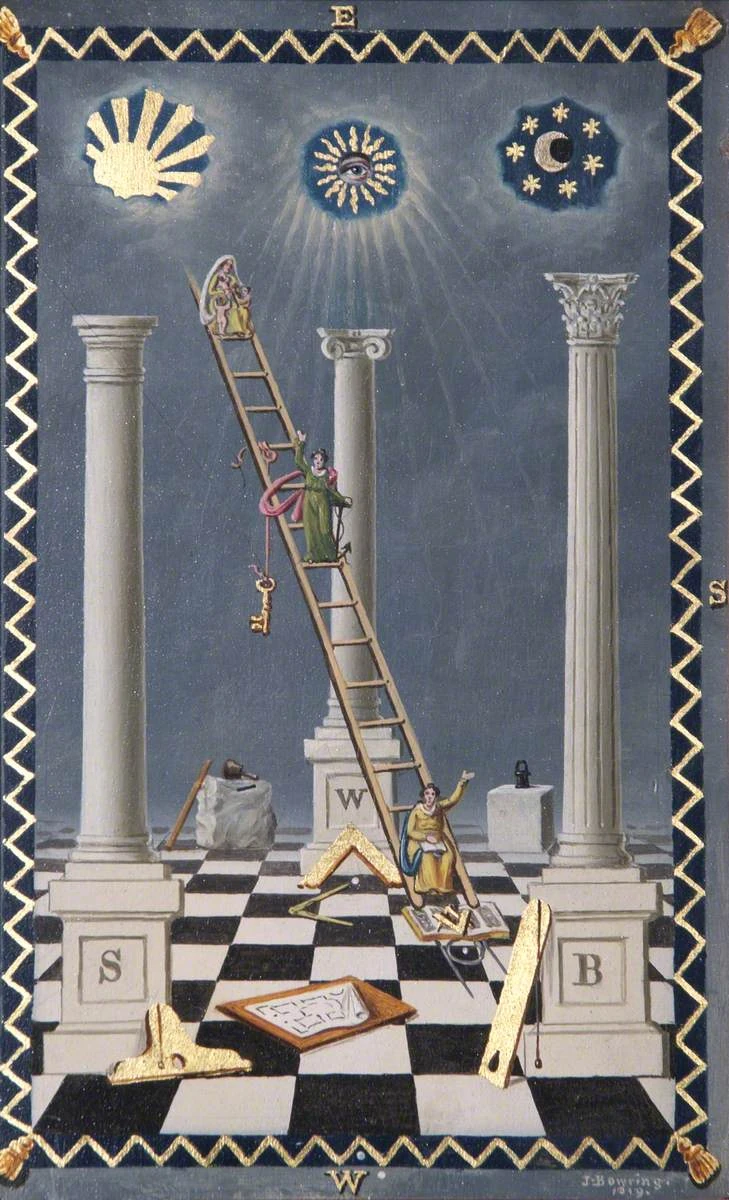
Josiah Bowring, First Degree tracing board, early 19th century. Pillars, Jacob's ladder, and the square and compasses on a chequered floor. Museum of Freemasonry, London. 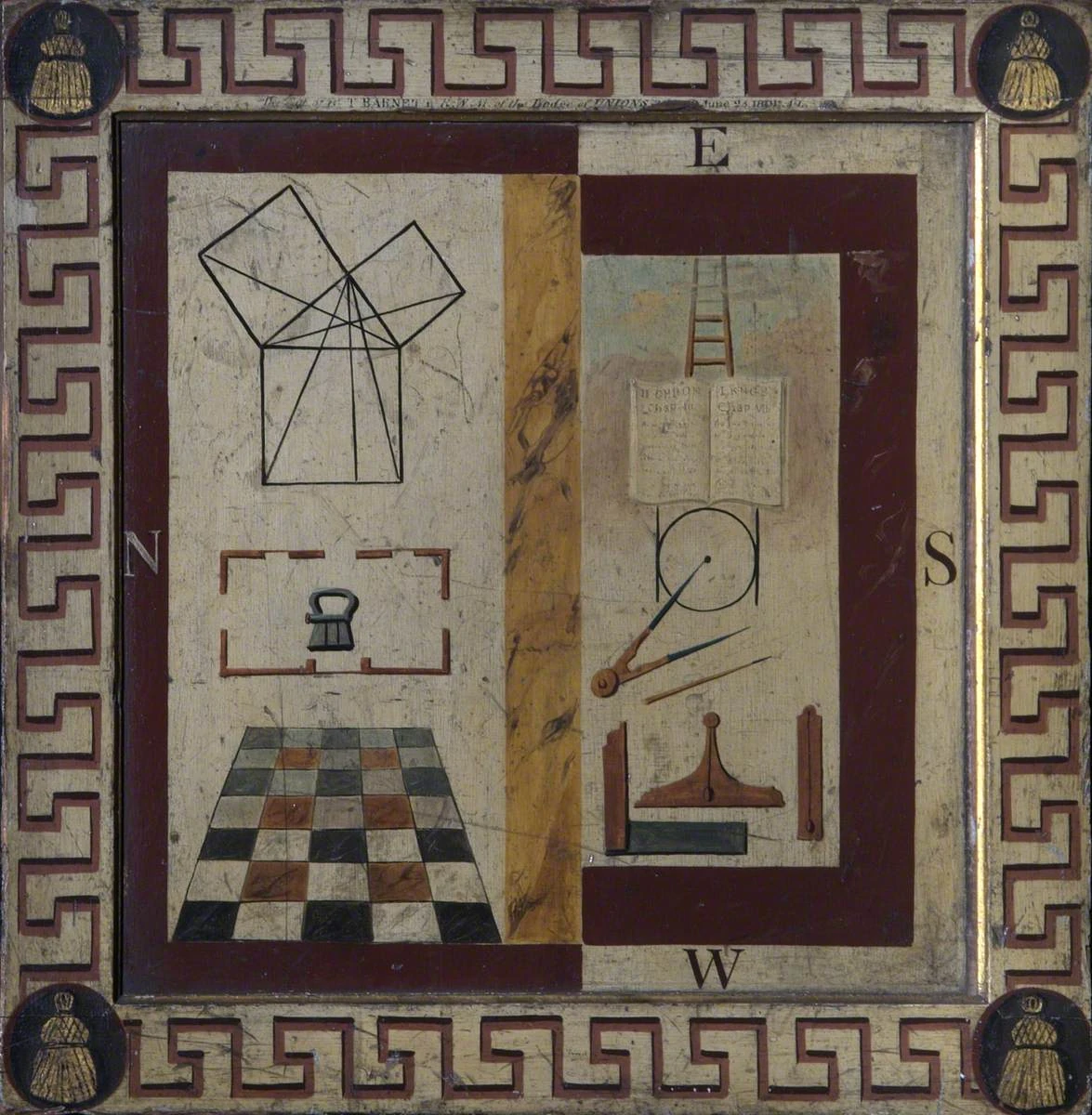
Tracing board, unknown artist. At top left, Euclid's 47th proposition, the same diagram that lies on the floor in Anderson's frontispiece. Museum of Freemasonry, London. I confess I find this part of the story rather dull: a club of gentlemen dressed as builders, who built nothing and claimed to hold the plan of everything. But dull ideas are often the ones that last. Seventy years later George Washington, wearing a Masonic apron, laid the cornerstone of the United States Capitol with a silver trowel.
The heretics
Not everyone accepted the idea. In 1794 William Blake took the image of God with the compasses and turned it into a warning.
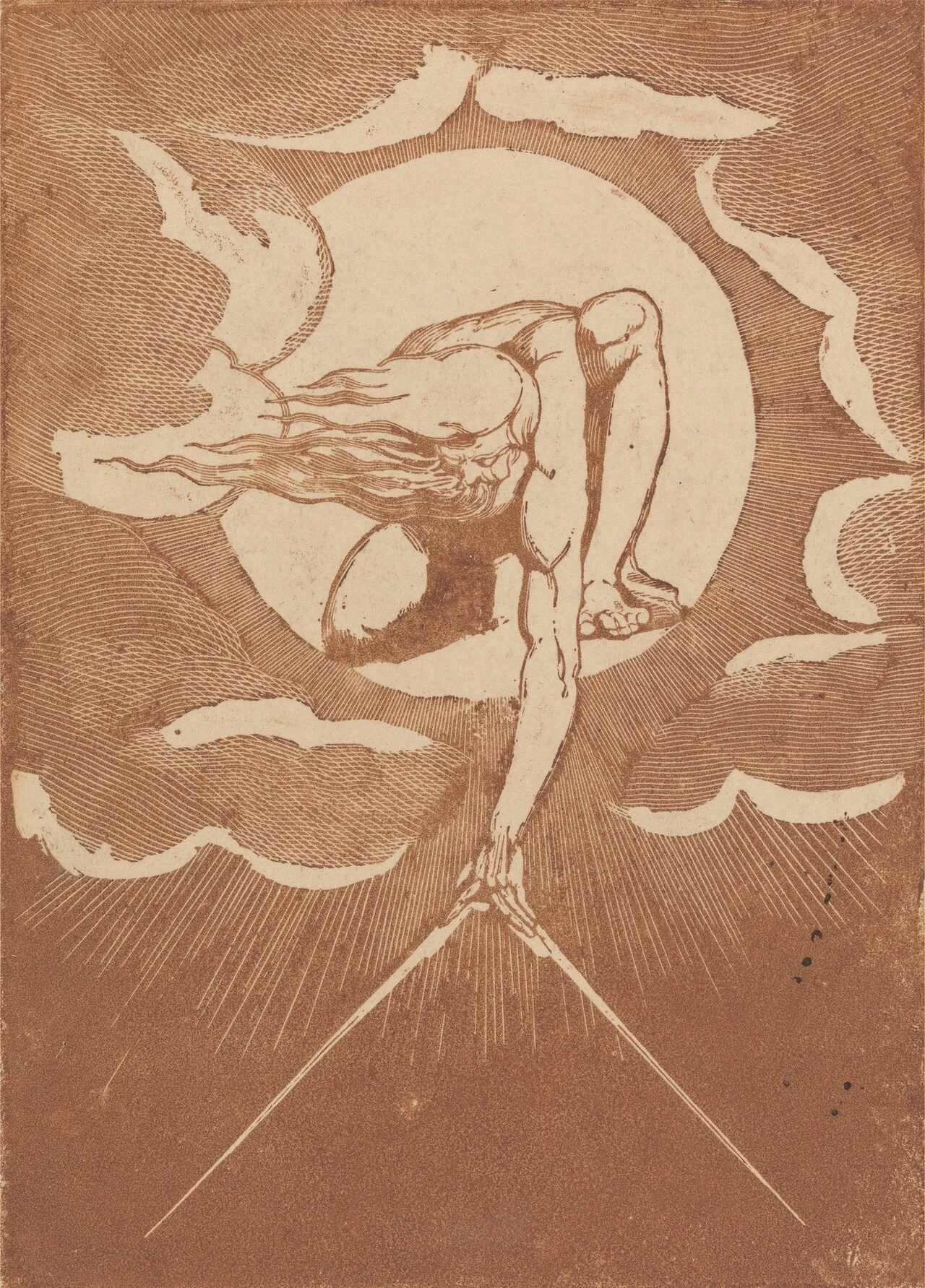
Blake, The Ancient of Days, 1794. Urizen, Blake's god of reason and law, fixing the limits of the world with a pair of dividers. 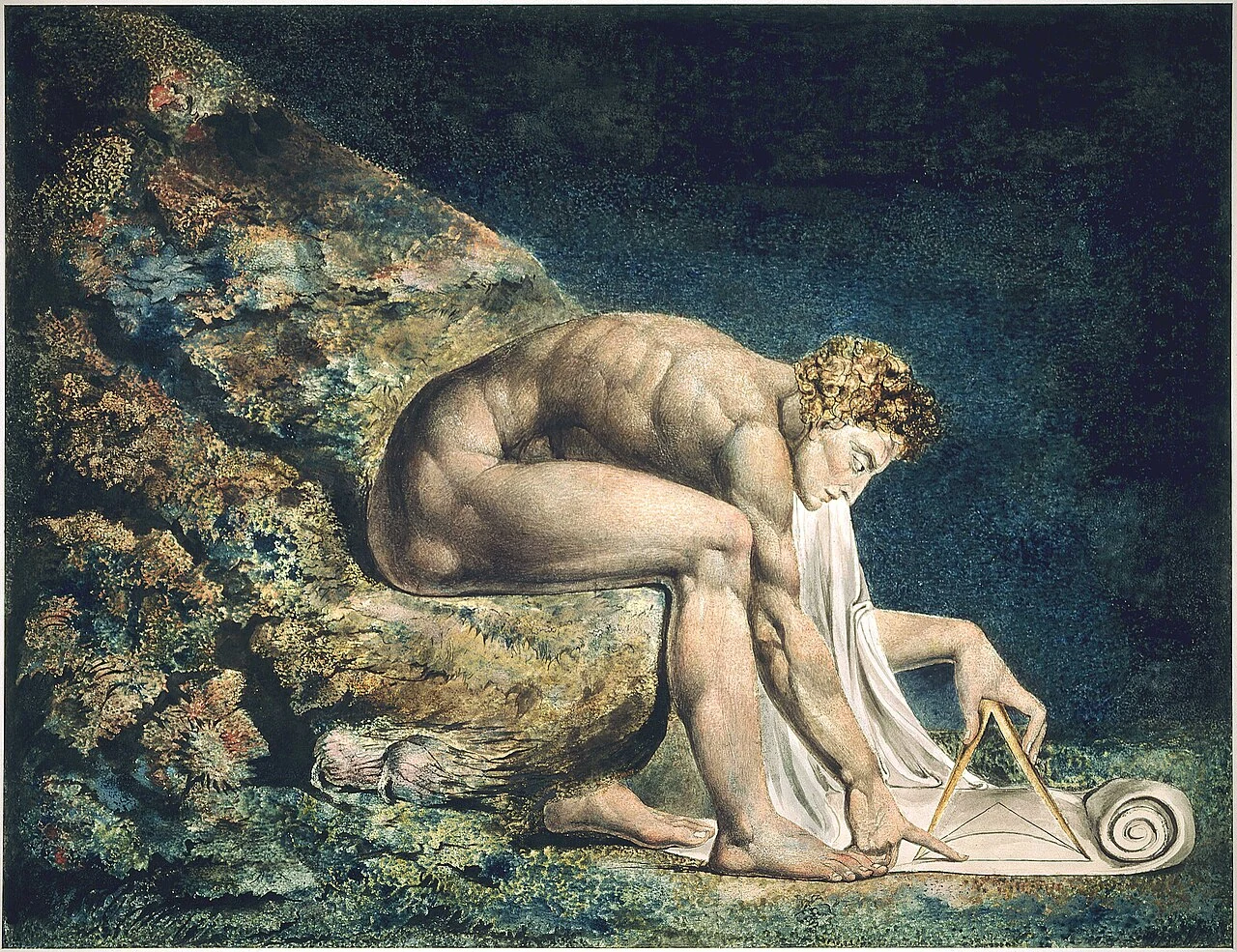
Blake, Newton, 1795–c.1805. The scientist at the bottom of the sea, so absorbed in his diagram that he has turned his back on the living rock behind him. For Blake, the god with the compasses was not a creator but a jailer. He stood for reason that forgets it is only one of our faculties and begins to draw the limits of the whole world.
May God us keep
From Single vision & Newton's sleep!Blake, letter to Thomas Butts, 1802Goethe made a similar protest through botany. In The Metamorphosis of Plants (1790) he argued that all the parts of a flower, sepals, petals and stamens, are transformed leaves. Form, for him, grows from inside the plant through variation; it is not stamped on from outside. He then spent twenty years in a losing argument with Newton about colour.
The West always had these dissenters. They were rarely the ones who received the funding.
ε΄The craftsman becomes a company
Now jump to the present. Replace the compasses with a computer chip, take away the gods, and the structure of the story is still there.
About 1220. A mind outside the world, measuring chaos. 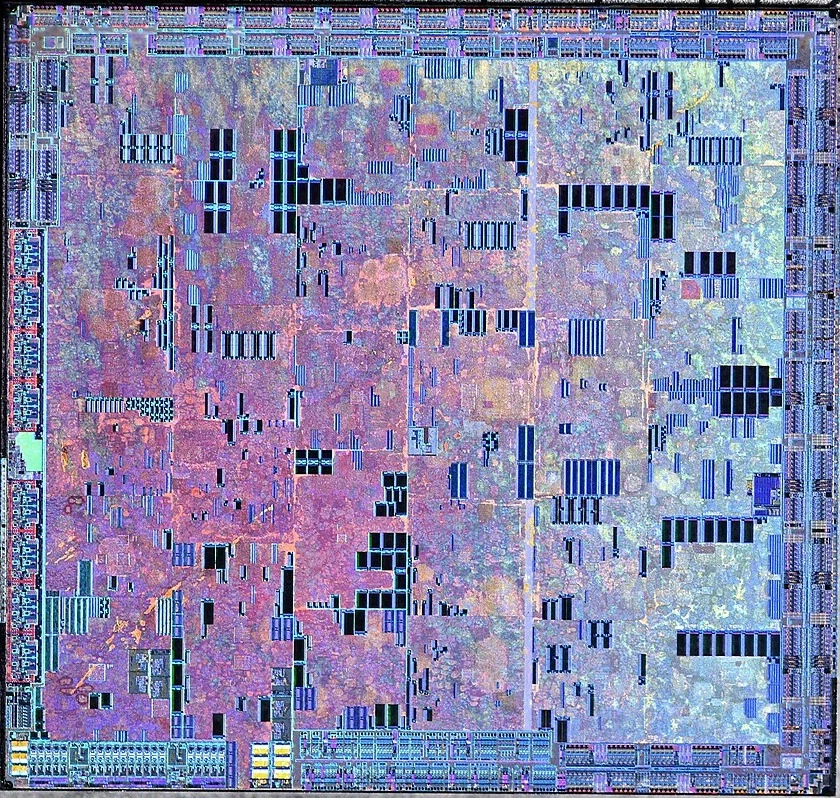
2006. An Nvidia G71 graphics chip with its cover removed: sand, melted and measured. Photo: Martijn Boer, public domain. Below is the creation story of the Timaeus, step by step. Switch it to 2026 to see how each step corresponds to the way AI is built today. The names change; the steps stay the same.
- The Goodτἀγαθόν The Good"God desired that all things should be good and nothing bad, so far as this was attainable." 30a "Benefits all of humanity"The mission statement of the OpenAI Charter. Every lab has its own version.
- The makerδημιουργός The DemiurgeA craftsman outside the world, "free from jealousy", who wants everything to be "as like himself as they could be." 29e The labA few hundred people outside the system they are building, who want it to share their values. They call this alignment.
- The patternπαράδειγμα The FormsHe works "after an eternal pattern", copying perfect originals into the world. 28a Latent spaceAn MIT paper argues that large models converge on "a shared statistical model of reality, akin to Plato's concept of an ideal reality."
- The receptacleχώρα The chōra"The receptacle, and in a manner the nurse, of all generation." Formless and shaking, with everything mixed together. 49a Data and computeThe text of the internet and the datacenters it is fed into. Formless and noisy, with everything mixed together.
- The mixing bowlκρατήρ The kraterHe blends Same, Different and Being in a bowl, cuts the mixture into strips and bends them into circles. 35a, 41d The training runThe data is mixed, gradient descent runs for months, and a finished model is taken out.
- The resultψυχή The World Soul"A living creature truly endowed with soul and intelligence." 30b The model"A country of geniuses in a datacenter." Dario Amodei, 2024.
- The helpersθεοὶ θεῶν The younger godsThe craftsman hands the messy mortal work to lesser gods: "Do ye therefore make them." 41c AgentsThe model hands tasks on to smaller agents and tools.
- The repair90d Tuning the soulHuman souls are born with their circles in disorder. Studying the heavens puts them back in line. AlignmentTraining with human feedback, testing, and a 30,000-word constitution used in training.
I am aware that I have just done what this essay questions: I have taken a messy reality and pressed it into eight neat boxes. Some rows fit better than others, and the comparison between agents and the younger gods is half a joke. One row is wrong in an interesting way.
The row that doesn't fit
It is the row about the Forms. For Plato, the Forms come first and are then copied into matter. The "Platonic representation" found in AI works the other way round. Nobody puts it into the model. It appears out of the data as models grow larger, and vision models and language models, trained on completely different material, end up organising the world in similar ways. The form is found inside the mess, not stamped onto it.
This is not Plato's finger pointing upward. It is Aristotle's hand, held flat over the ground. The most Platonic-sounding discovery in AI turns out to be something that grows, and this, I think, is the centre of the whole question.
A constitution for the soul
The last row is less of a stretch than it may seem. The Timaeus begins the morning after a long conversation about the ideal city, which Socrates briefly summarises: who governs, who guards, how citizens are born and educated. That conversation is usually identified with the Republic, whose Greek title, Politeia, is commonly translated as "constitution". Plato first writes the laws of the city; then he describes a cosmos and a soul that match them.
In January 2026 the company Anthropic published the constitution for its Claude models: about 30,000 words on values and character, used directly in training. Inside the company an earlier version had been "endearingly known as the 'soul doc'". Among the outside reviewers were two members of the Catholic clergy.
I do not mean this as mockery. Writing down what you hope a mind will be is more honest than pretending you are not shaping it. The method is also more careful than it first appears. The document mostly explains reasons rather than listing rules, on the theory that a model that understands why will behave better in new situations than one that has memorised instructions. This is the half of the Timaeus that is usually forgotten: reason persuading Necessity instead of overpowering her.
Still, a small group of people writes down what is good and trains it into a mind. The compasses are still in the hand.
(Disclosure: parts of this section were drafted together with Claude, which was trained on that document. It had opinions.)
Plato, Bacon or a lab?
Here are eight quotations. Some were written in 360 BC or 1627, others after 2010. Try to guess which are which.
"Out of disorder he brought order, considering that this was in every way better than the other."
Plato, Timaeus 30a."Solve intelligence, and then use that to solve everything else."
DeepMind's mission, as Demis Hassabis describes it."We take all an oath of secrecy, for the concealing of those which we think fit to keep secret."
Bacon, New Atlantis, 1627, on Salomon's House."We expect that safety and security concerns will reduce our traditional publishing in the future."
OpenAI Charter, 2018."To make divers new plants, differing from the vulgar; and to make one tree or plant turn into another."
Bacon, New Atlantis, 1627. Synthetic biology, four centuries early."What I cannot build, I cannot understand."
Written into the DNA of JCVI-syn1.0, the first cell controlled by a synthetic genome, 2010."You shall weave together the mortal and immortal."
Plato, Timaeus 41d. The craftsman instructing the younger gods."Fixing the climate, establishing a space colony, and the discovery of all of physics."
Sam Altman, The Intelligence Age, 2024.The new harmony
A schematic scaling law, not real data. It shows only the shape of the relationship. Plato built the World Soul from a handful of numbers: 1, 2, 3, 4, 8, 9, 27. AI research found its own governing numbers in 2020, when Jared Kaplan and colleagues at OpenAI showed that the error of a language model falls as a power law as the model, the data and the computing power grow, "with some trends spanning more than seven orders of magnitude."
On a graph with logarithmic axes this relationship is a straight line: one ratio that holds at every scale, which is exactly the kind of thing the Pythagoreans revered. Sam Altman summed it up this way: "deep learning worked, got predictably better with scale, and we dedicated increasing resources to it." The harmony of the spheres has become an investment plan.
The craftsman signs his work
Synthetic biology tells the same story in a wetter medium. In 2010 Craig Venter's team designed the genome of a bacterium on a computer, assembled it from "four bottles of chemicals", and transplanted it into a living cell of a related species, where it took control. Venter described the result as "the first self-replicating species we've had on the planet whose parent is a computer."
Then they signed their work. The synthetic genome carries coded "watermarks": the names of 46 scientists, an email address and three quotations. One of them appeared in the quiz above. It was meant to quote Richard Feynman, but Feynman's blackboard actually read "What I cannot create, I do not understand." The copy came out slightly different from the original, which would not have surprised Plato.
The phrase "biology is code" follows the same pattern as the table above. DNA is the Form, the body is a product built from it, and disease is an error to be corrected. Bacon's Salomon's House had already promised new species and "one tree or plant turn into another". And Venter himself said his team had not created life from nothing, because they needed a living cell to start the genome. This is the receptacle again. The craftsman never works from nothing.
The pattern repeats each time: a mind outside the system, a perfect model, a disordered material, and the belief that the right equations will bring the material into order.
Physics has its version too. The physicist Max Tegmark argues that the universe does not merely obey mathematics but is a mathematical structure. The simulation argument puts a craftsman outside the world once more, this time with a datacenter. And Atlantis has returned. Plato told its story as a warning about a brilliant empire that overreached and sank. Bacon reused the name as a promise. Silicon Valley mostly remembers Bacon's version.
ϛ΄What the machines actually do
There is an irony in all this. The technology itself does not work the way the craftsman story suggests.
The biggest lesson that can be read from 70 years of AI research is that general methods that leverage computation are ultimately the most effective, and by a large margin.Rich Sutton, The Bitter Lesson, 2019
The history of AI is full of attempts to design intelligence directly: expert systems, hand-built catalogues of knowledge, carefully engineered features, grammars and rules. Each was a blueprint, and each was eventually overtaken by simpler methods that learned from data. Sutton's conclusion is that we should build systems that can discover things as we do, "not which contain what we have discovered".
Nobody designed the inner structure of a large model. It was grown. Billions of numbers begin as random noise and are adjusted, step by step, by gradient descent, until structure forms. This is less like a craftsman copying a model into matter, and more like what Laozi called the uncarved block, taking shape by itself.
The machine grows like a plant, but the people who steer it speak like architects.
This gap concerns me more than any benchmark. It is the belief that something grown can be fully specified, and that whatever does not fit the specification is an error to be deleted. Gardeners prune, of course. But a good gardener does not forget that it was the plant that did the growing.
七The tree the carpenter walked past
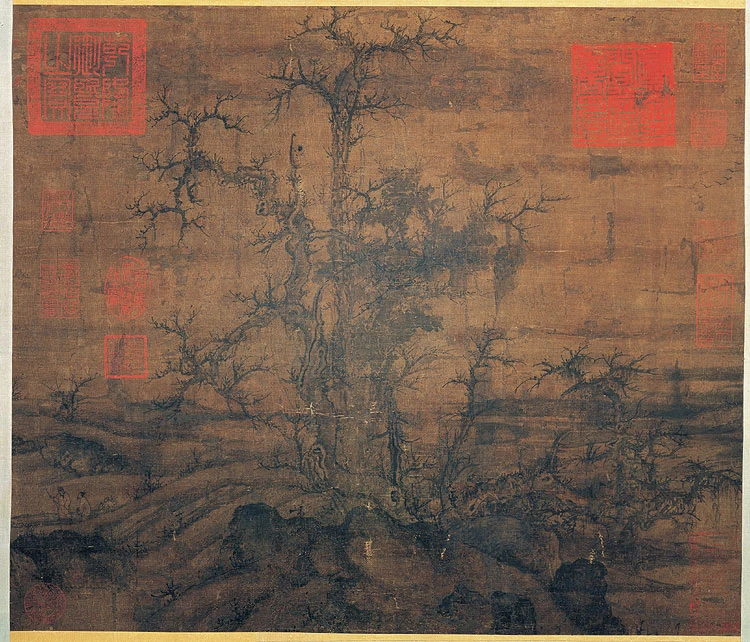
Anonymous, Small Scene of Wintry Trees, Song dynasty. There is not a single straight line in it. At roughly the same time that Plato was writing, give or take a few decades, a Chinese writer we know as Zhuangzi told the following story.
A master carpenter named Shi is travelling with his apprentice. At a village shrine they pass an enormous oak, wide enough to shade thousands of oxen, so tall that its lowest branches begin above the hilltops. Crowds gather to look at it. Shi does not even turn his head.
The apprentice runs after him: I have never seen timber like that. Why won't you look at it? Shi dismisses it. The wood is worthless. Make a boat of it and the boat sinks. Make a coffin and it rots. A door would ooze sap, a pillar would be eaten by insects. The tree is useless, and that is why it has lived so long.
That night the oak appears to him in a dream. In paraphrase: What are you comparing me with? With useful trees? Fruit trees are stripped and broken as soon as their fruit is ripe. Their usefulness ruins their lives. I have been trying to be useless for a very long time. I nearly died more than once, but now I have succeeded, and my uselessness is my great use. If I had been useful, would I ever have grown this large?
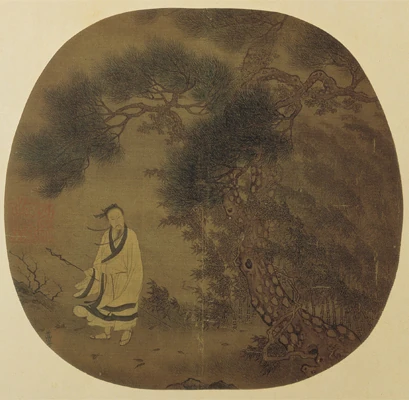
Attributed to Xu Daoning, Holding a Wand under the Pine Tree, Song dynasty. The chapter ends with a sentence that sums up the whole story:
Everyone knows the use of the useful. Nobody knows the use of the useless.人皆知有用之用,而莫知無用之用也Zhuangzi, ch. 4
Compare this with the Timaeus. Plato's god is a craftsman who looks at raw material and sees what it ought to become. In Zhuangzi's story, the raw material scolds the craftsman for failing to see what it already is.
Below is a tree drawn without a plan, from one simple, slightly crooked rule repeated many times. Click to grow another.
Open the post page to grow the trees.
There are exactly five regular solids; Euclid proved that a sixth is impossible. There is no limit to the number of crooked trees.
The hole in the wheel
Plato's system also contains a kind of emptiness: the receptacle, the chōra. He is clearly uneasy about it. It can be grasped, he says, only by "bastard reasoning", as if in a dream. Laozi, in chapter 11 of the Tao Te Ching, puts exactly this emptiness at the centre:
Thirty spokes share one hub. It is the empty space that makes the cart useful.三十輻共一轂,當其無,有車之用Tao Te Ching, ch. 11
The idea is the same, but its value is reversed. For Plato, empty space is the uncomfortable basement of the cosmos. For Laozi, it is what makes things useful. Laozi's ideal is not the perfectly cut stone but pu, the uncarved block: the wood as it was before anyone took a chisel to it.
Joseph Needham, the Cambridge biochemist who devoted his life to Science and Civilisation in China, tried to sum up the Chinese view of nature in one phrase:
An ordered harmony of wills without an ordainer.Joseph Needham, 1956
Order without anyone giving the orders. I know of no sentence in English further from the Demiurge.
Buddha in this body
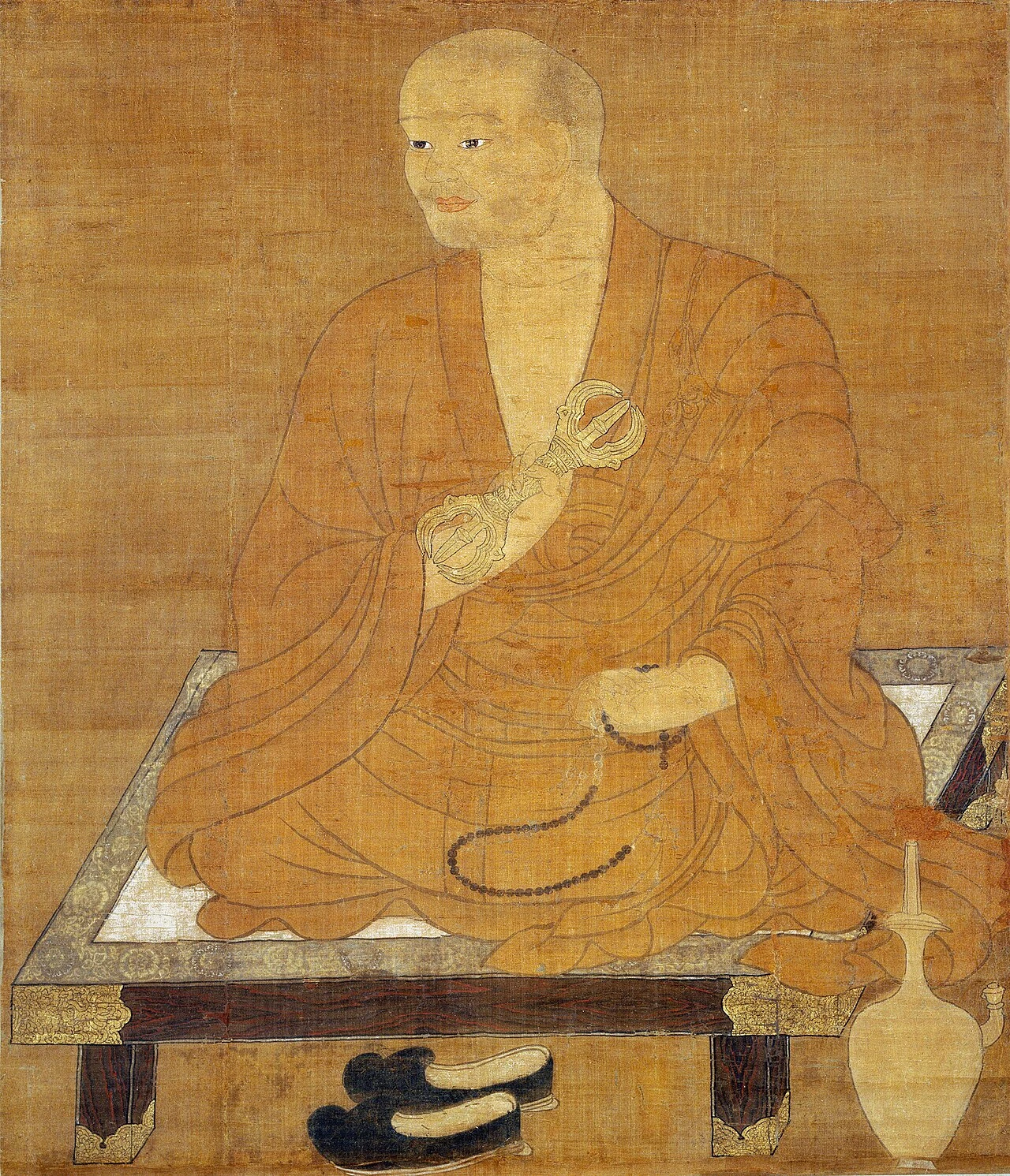
Kūkai (774–835), from Eight Patriarchs of the Shingon Sect. In 804 a Japanese monk named Kūkai sailed to Chang'an, the Chinese capital, studied esoteric Buddhism with the master Huiguo, and returned to Japan to found the Shingon school. His central teaching is sokushin jōbutsu (即身成仏): becoming a Buddha in this very body. Not after death, and not in a better world, but here.
For Plato, the body is what throws the soul into disorder. For Kūkai, the body is the instrument of practice. The practice works through the "three mysteries": the hands, through gestures called mudras; the voice, through mantras; and the mind, through the images of the mandala. One does not escape the confusion by thinking alone. One tunes it with the whole body.
Kūkai's list of elements is revealing too: earth, water, fire, wind, space and consciousness. Mind is one of the elements. Plato's elements are lifeless triangles that need a soul brought in from outside. Kūkai's already contain awareness:
The six great elements interpenetrate without obstruction, in eternal union.六大無碍常瑜伽Kūkai, Sokushin jōbutsu gi
The same cube
Here the story takes a strange turn. In old Japanese cemeteries there are gorintō, stone stupas made of five stacked shapes, one for each element:
Plato · heaven = dodeca
Plato · air = octa
Plato · fire = tetra
Plato · water = icosa
Plato · earth = CUBE空 void · jewel
風 wind · crescent
火 fire · pyramid
水 water · sphere
地 earth · CUBEThe earth is a cube, just as in Plato. Two traditions with almost no contact both gave the earth the shape of a cube, and then used it in opposite ways.
Look at photographs of old gorintō and you see stones softened by centuries of rain, spotted with lichen, sometimes leaning a little. A Platonic cube is meant to stay exact forever. These cubes have been allowed to age.
Plato uses geometry as a mould, something pressed into matter from outside to make it behave. Shingon uses geometry as a mirror. Its great mandalas are not plans for building the world. They are maps of what a person already is, and the practitioner enters them with body and voice.
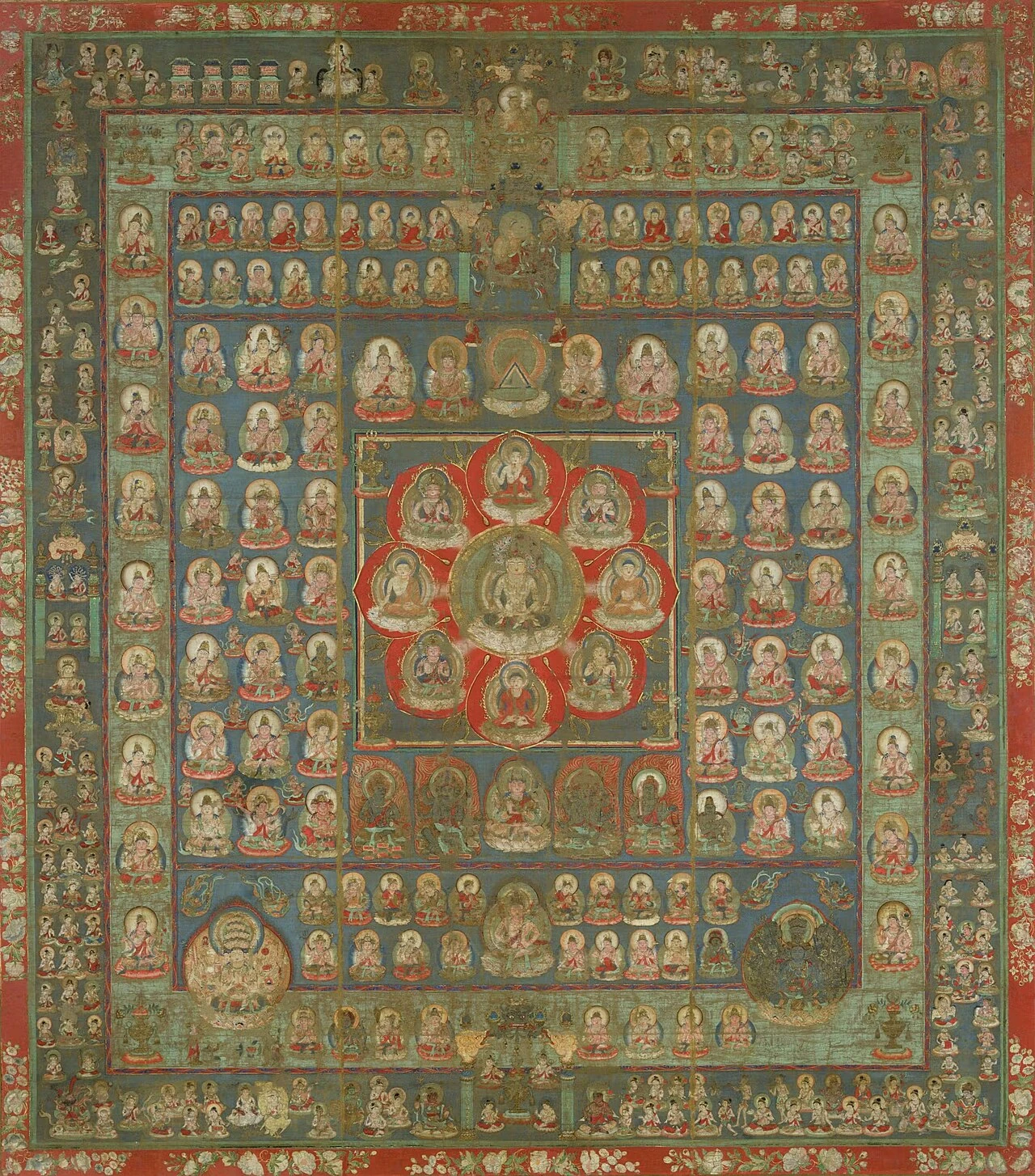
The Womb Realm mandala (Taizōkai), one of Shingon's two great mandalas. Strict geometry, used as a mirror for the body rather than a mould for matter. Further west, in India, the ideas become stranger still. Kashmir Shaivism describes the basic texture of reality as spanda: a throb or pulse, consciousness vibrating and recognising itself in everything it becomes. Other Indian traditions speak of līlā, play: the cosmos as something performed rather than built.
Chinese Huayan Buddhism describes Indra's net: an endless web with a jewel at every knot, each jewel reflecting all the others. It is the opposite of a world made of five separate solids. In Indra's net nothing has a shape of its own; everything exists through its relations.
The Demiurge- The cosmos is built
- Order is imposed from outside
- Chaos is the enemy, persuaded at best
- The body disturbs the soul
- Geometry as a mould
- You improve yourself by studying the mechanism
The Crooked Tree- The cosmos grows, or plays
- Order arises from within
- Chaos is material, and a source
- The body is the instrument
- Geometry as a mirror
- You stop forcing, and notice
The picture is not so simple
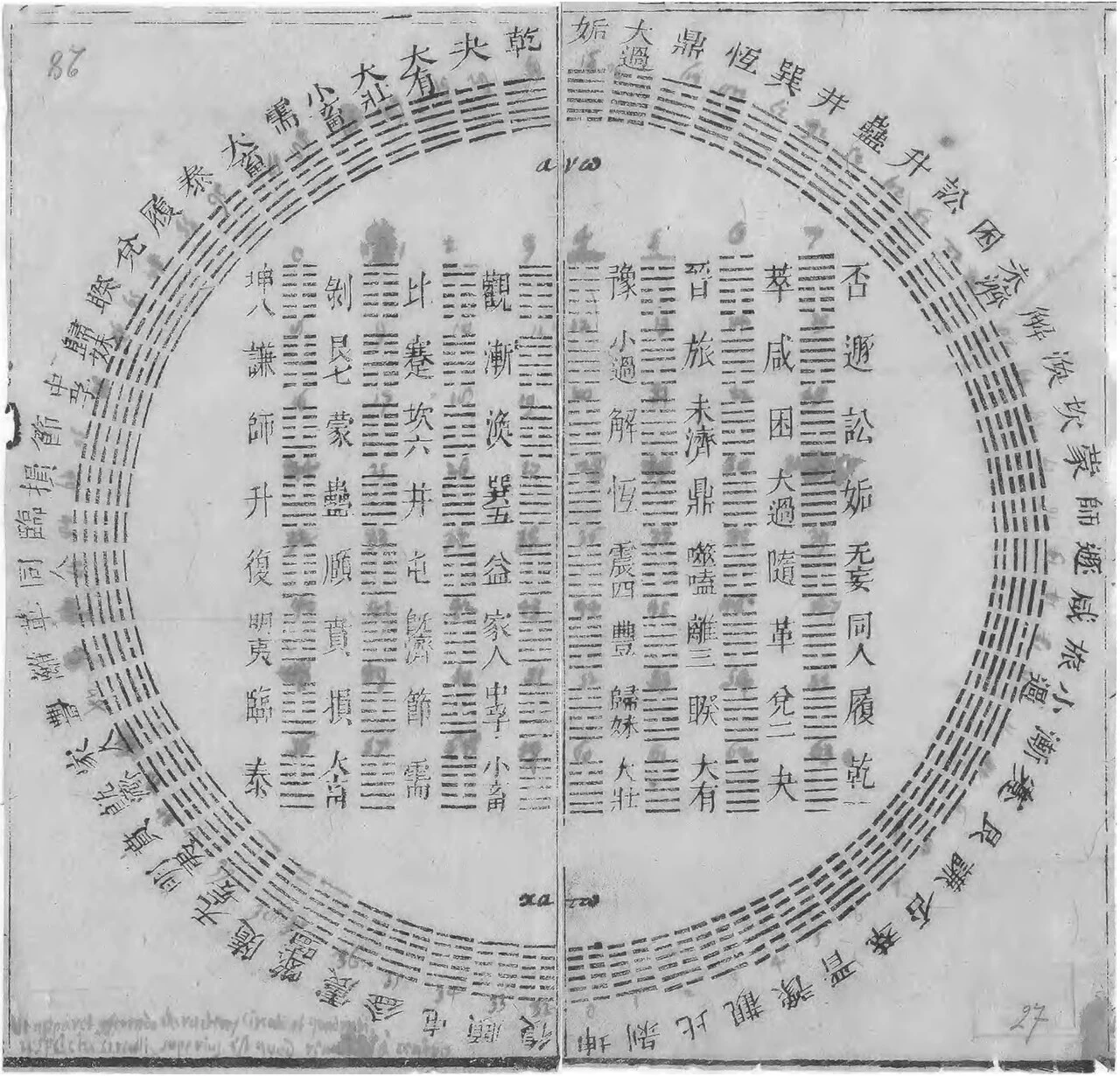
The I Ching hexagram diagram that Joachim Bouvet sent from Beijing to Leibniz in 1701, with Leibniz's own pencil numbers. It would be wrong, though, to present the East as purely the side of the tree. Kūkai's school had its own version of Salomon's House. Mikkyō, the name of his tradition, means "secret teaching": initiation by a master, knowledge passed on behind closed doors, rituals that may not be described to outsiders. In its structure it is closer to a Masonic lodge than I would like.
And for centuries the Tao Te Ching was also read as a handbook for rulers. Han Feizi, the hard-minded Legalist whose ideas the Qin state used to build China's first empire, wrote commentaries on Laozi. Wu wei, non-action, can mean letting the river find its own course. It can also mean a ruler so powerful that he never needs to lift a finger.
In 1701 Joachim Bouvet, a Jesuit in Beijing, sent Leibniz a diagram of the 64 hexagrams of the I Ching, in the arrangement of the Song philosopher Shao Yong. Looking at the broken and unbroken lines, Leibniz recognised his own binary arithmetic of zeros and ones.
Every chip that runs today's AI counts in a number system whose European inventor believed he had found it confirmed in an ancient Chinese book of divination. These traditions were never sealed off from one another. They have been borrowing from each other for centuries.
八So does the East win?
There is a popular version of this story. The West runs toward a cliff, building a god out of silicon and rewriting life as code, while China, Iran and others rediscover their non-Platonic roots and inherit the century.
I understand its appeal, but I do not fully believe it.
China. There is a real tradition of systems thinking there. Qian Xuesen wrote Engineering Cybernetics at Caltech in 1954, was deported during the McCarthy era, and returned to China, where he helped build the missile and space programmes and a whole culture of planning based on systems science. "Ecological civilization" was written into the Chinese constitution in 2018. But China is also the most thoroughly engineered state on Earth. The writer Dan Wang calls it an engineering state, in contrast to the "lawyerly society" of the United States: five-year plans, perfectly straight high-speed railways, whole cities built within a decade. On some days Beijing looks much more like the Demiurge than Palo Alto does.
Iran. Suhrawardi's 12th-century Philosophy of Illumination describes reality as degrees of living light. Mulla Sadra's doctrine of "substantial motion" holds that being itself is continuous change: nothing simply sits still, being a cube. This is beautiful, and far from lifeless geometry. But Suhrawardi counted Plato among his teachers. The philosophy of illumination is Platonism set alight, not its opposite. And states are not governed by metaphysics. They are governed by oil, demography and fear.
Iran also offers a third kind of geometry, which belongs to neither side of this essay. In 2007 the physicists Peter Lu and Paul Steinhardt showed that the tile patterns of the Darb-i Imam shrine in Isfahan, built in 1453, follow rules very close to those of quasicrystals: patterns that are strictly ordered and yet never repeat. In Europe such patterns were described only in the 1970s, by Roger Penrose.
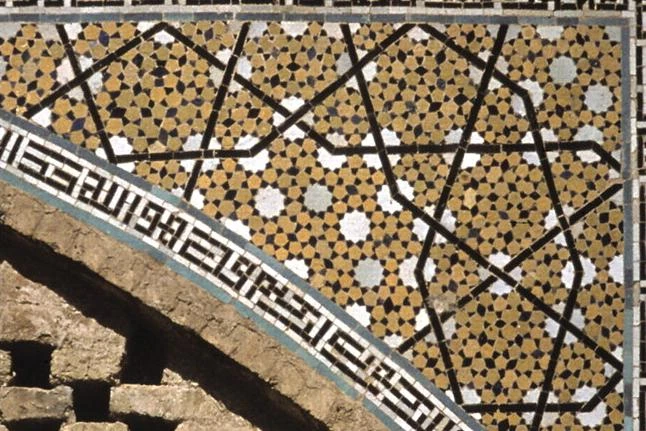
Spandrel of the Darb-i Imam shrine, Isfahan, 1453. The large pattern of lines is repeated at a smaller scale inside itself. Public domain. Below is a pattern of the same family. It is made with a modern method the Isfahan craftsmen did not use, but whose result they would recognise: a hidden tiling of two rhombs, shown by the faint lines, carries a band of interlaced strapwork. Every line follows a strict rule, yet the pattern never repeats, however far it is extended. Click for another.
Open the post page to draw the pattern.
This is neither the craftsman's mould nor the crooked tree. It is order that is completely exact and still never closes. If there is a geometry for the century ahead, it may look more like this than like either of the others.
The dividing line does not run between East and West. It runs through every laboratory, every ministry and every person.
On one side is the craftsman, on the other the tree: imposing order, or letting it grow. The West has Blake and Goethe, Gregory Bateson, ecology, cybernetics and the complexity scientists of the Santa Fe Institute. The East has the largest top-down planning machinery ever built. Everyone carries both.
Where I do agree with the popular version is this: the societies that do well in this century will be the ones that can hold both. The compasses are not the villain. They gave us bridges, vaccines and the chips this page is running on. The skill is to pick them up and then to put them down again, to build the trellis and let the vine do the rest. Systems that treat disorder as an error tend to be broken by it. Systems that treat it as material can work with it. Most discoveries happen at the boundary between order and chaos, not on either side of it.
Plato himself knew this. It is in his text: reason persuades Necessity; it does not abolish her. The problem is not the Timaeus. The problem is twenty-four centuries of reading it as an engineering specification instead of as a likely story.
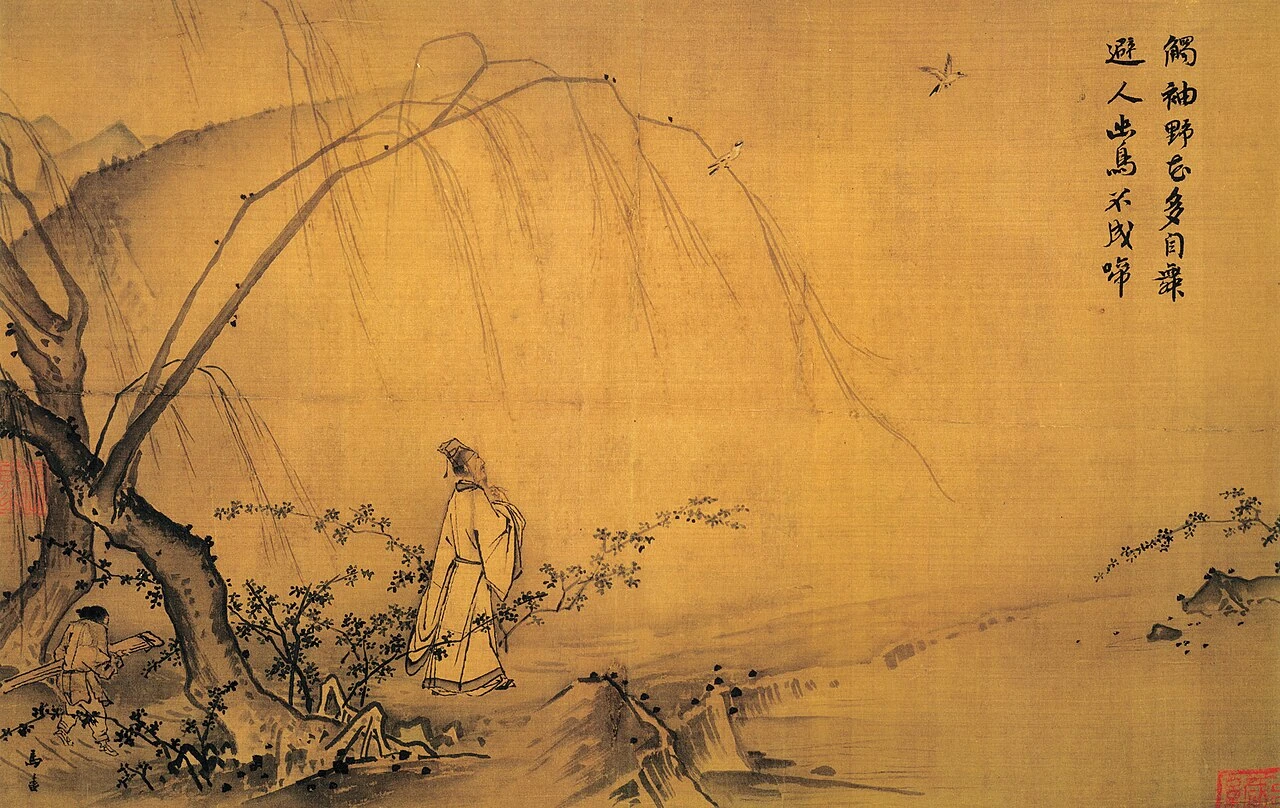
Ma Yuan, Walking on a Mountain Path in Spring, Song dynasty, c. 1200. A scholar, a willow, a bird, and a great deal of empty space. The DemiurgeThe myceliumSolve intelligenceNotice it is already everywhereAlignment as enforcementAlignment as tuningFive perfect solidsCountless crooked treesGeometry as a mouldGeometry as a mirrorI want to return once more to Zhuangzi's oak. It survived because it was useless. Nobody wanted its wood.
That way out is not open to what we are building now. AI may be the most useful tree anyone has ever grown, and carpenters everywhere are already standing beneath it with their saws. So the question is not how to stay useless.
The question is whether we can learn to use something without cutting it into the shape of our plans.
Plato's World Soul turns in perfect circles. A Zen painter draws a circle in a single breath and leaves it open.
The two circles look alike. One is a plan, the other a breath.
Close this page, and go and look at a crooked tree.
櫟
Further reading
- Plato, Timaeus, trans. Jowett. Key passages: 29d, 30a, 35a–36d, 37d, 43a–e, 47b–c, 48a, 52b, 53c–56d, 90c–d.
- Zeyl & Sattler, "Plato's Timaeus", Stanford Encyclopedia of Philosophy.
- Zhuangzi, ch. 4, "In the World of Men", trans. Burton Watson (the carpenter and the oak).
- Laozi, Tao Te Ching, ch. 11 and 28.
- Joseph Needham, Science and Civilisation in China, vol. 2 (1956).
- Kūkai, Sokushin jōbutsu gi; Yoshito Hakeda, Kūkai: Major Works (1972).
- Francis Bacon, New Atlantis (1627) and Novum Organum (1620).
- Wolfgang Pauli, "The Influence of Archetypal Ideas on the Scientific Theories of Kepler" (1952), on the Kepler–Fludd feud.
- James Anderson, The Constitutions of the Free-Masons (1723).
- J. W. von Goethe, Versuch die Metamorphose der Pflanzen zu erklären (1790).
- Werner Heisenberg, Der Teil und das Ganze (1969), ch. 1, the Timaeus on the rooftop.
- Alfred North Whitehead, Process and Reality (1929).
- Rich Sutton, "The Bitter Lesson" (2019).
- Huh, Cheung, Wang, Isola, "The Platonic Representation Hypothesis" (ICML 2024).
- Kaplan et al., "Scaling Laws for Neural Language Models" (2020).
- OpenAI Charter (2018); Sam Altman, "The Intelligence Age" (2024); Dario Amodei, "Machines of Loving Grace" (2024).
- Anthropic, Claude's Constitution (2026).
- Gibson et al., "Creation of a Bacterial Cell Controlled by a Chemically Synthesized Genome", Science (2010).
- Dan Wang, Breakneck: China's Quest to Engineer the Future (2025).
- All artworks public domain, via Wikimedia Commons.
-
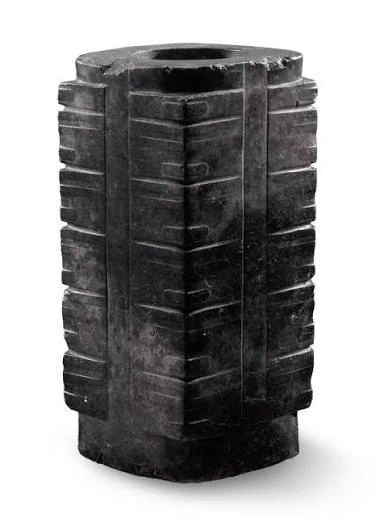
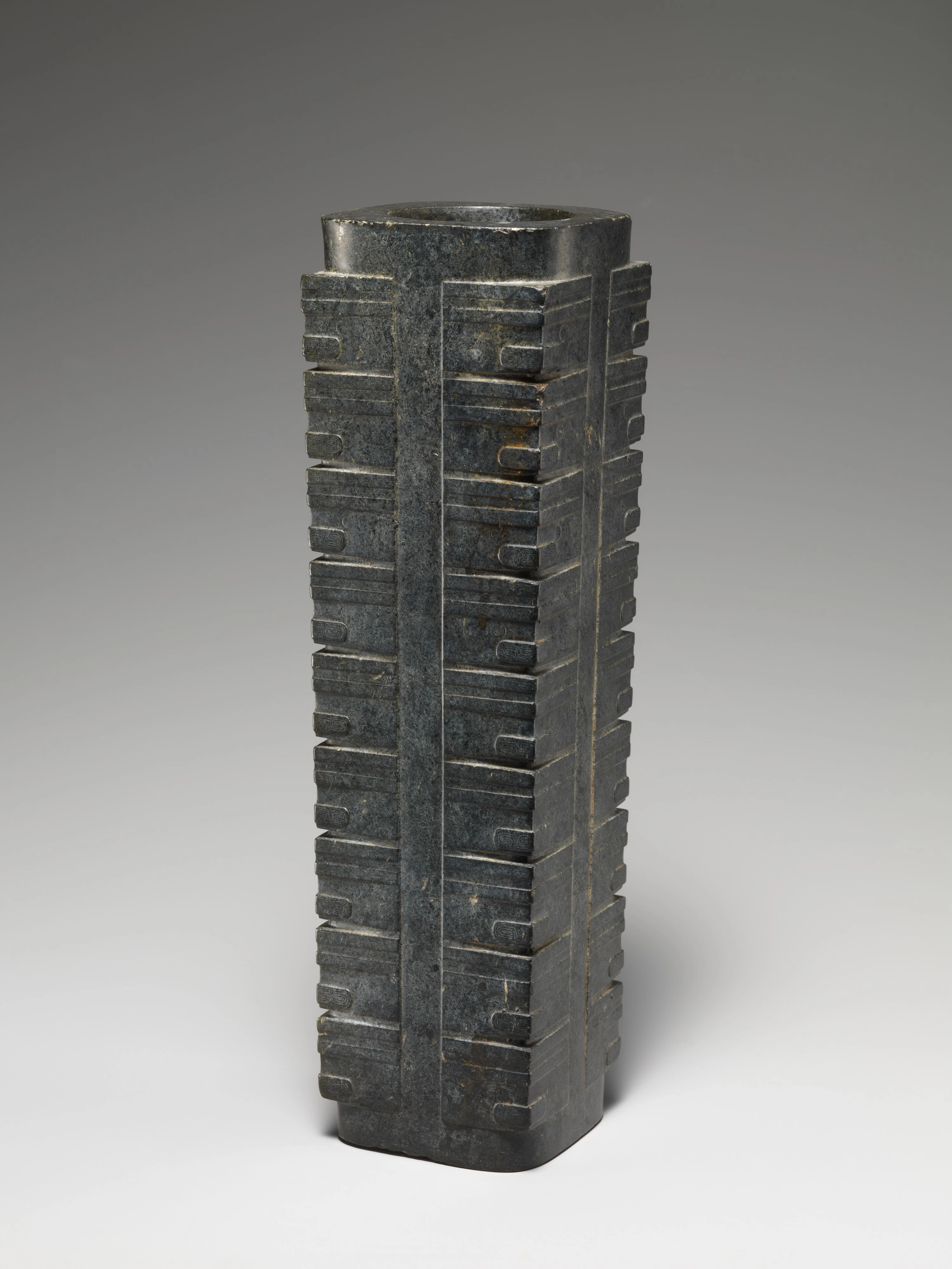
Jade Cong (琮)
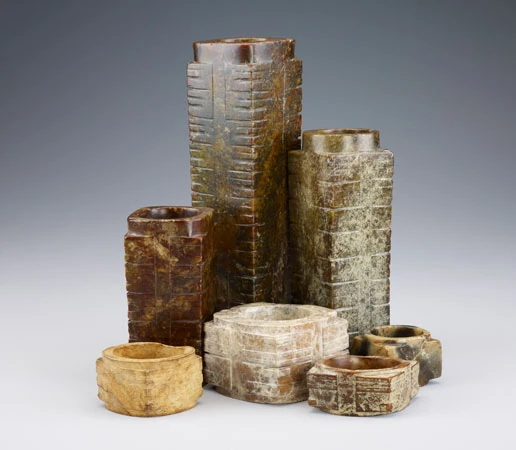
This is a Jade Cong (琮) from the Neolithic Liangzhu Culture (c. 3300–2200 BCE) in China. It is a perfect circular tube nested inside a square, hand-carved out of rock-hard nephrite before metal tools existed.
We find them stacked in wealthy tombs, covered in tiny, haunting "monster masks," yet we still don't know exactly what they were used for.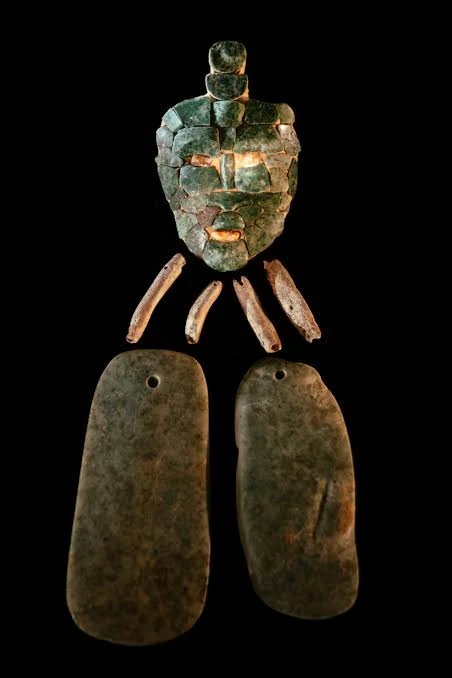
-
How an Ancient "Meme" Broke the Roman Empire
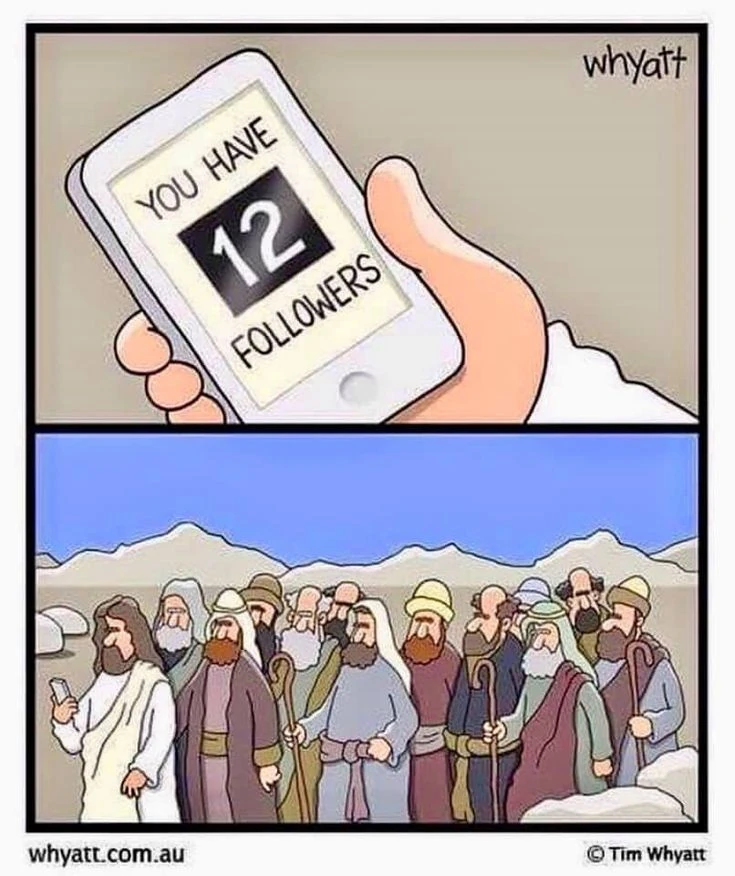
If you look at the birth of Christianity through a modern lens, it looks less like a traditional religious movement and more like the most successful viral marketing campaign in human history. It was essentially an ancient, hyper-viral social media meme that completely broke the algorithm of the Roman Empire.
Here is how a bizarre, underground message from a remote province took over the Western world using the original "social internet."
1. The Ultimate Clickbait Headline
Every viral post needs a hook that people can’t stop arguing about. The headline of early Christianity was utterly shocking: "A peasant executed by the state is actually the ruler of the universe, he beat death, and he wants to know you personally."
In the strict, honor-obsessed Roman world, a god who suffered the humiliating death of a common criminal was an absurd concept. It was offensive, counter-cultural, and generated massive "engagement." People couldn't stop talking about it—even if just to mock it.
2. Upgrading the Hardware (The Roman Internet)
The Roman Empire accidentally built the perfect infrastructure for a viral message to spread. They paved thousands of miles of highly secure, interconnected highways to move their armies. Early Christians hijacked this physical network to carry their message from city to city.
Combine those roads with Koine Greek—the universal trade language of the Mediterranean—and you had the ancient equivalent of high-speed Wi-Fi and a global interface language.
3. Open-Source Letters & Text Posts
The New Testament letters were the original chain emails. Written by early leaders like Paul, these documents weren't meant to be kept private. They were explicitly designed to be copied by hand, passed from town to town, and read aloud to public crowds.
They also packed complex theology into short, rhythmic, easily memorable slogans (early creeds) that illiterate people could memorize and pass along instantly to the next village.
4. Bypassing the Class Filter
The Roman social structure was heavily segregated by status, separating elites, citizens, women, and slaves. Christianity introduced a radical piece of code: "There is no slave or free, male or female, for you are all one."
By giving equal dignity to the marginalized, the movement unlocked a massive, untapped user base. When nodes of the network popped up in households, it spread vertically and horizontally overnight.
Within three centuries, this weird, status-defying message went from a handful of broke fishermen in a Roman backwater to the official religion of the entire empire. It is proof that a powerful, disruptive idea—packaged perfectly for its network—is almost impossible to delete.
-
Think different about Think different
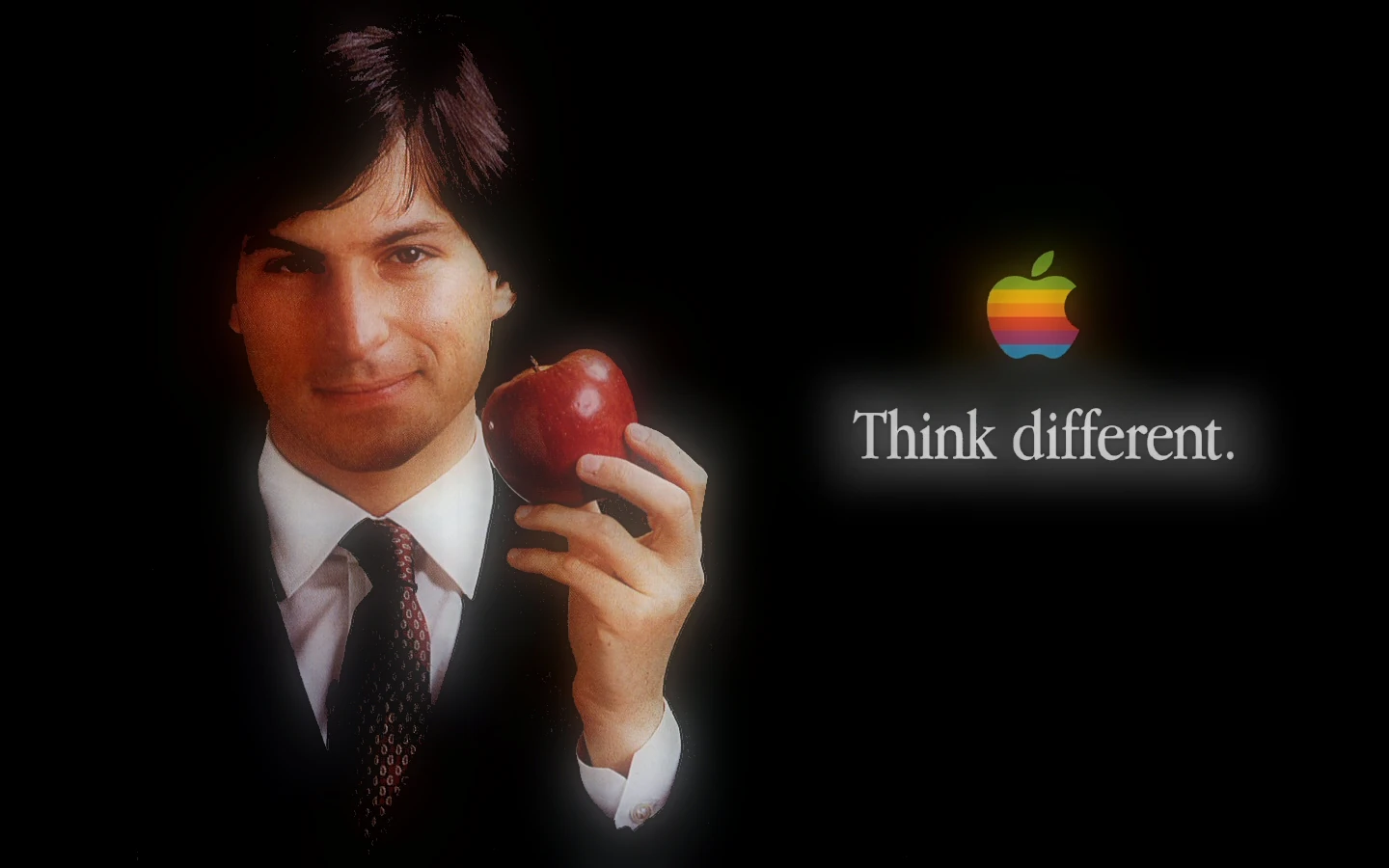
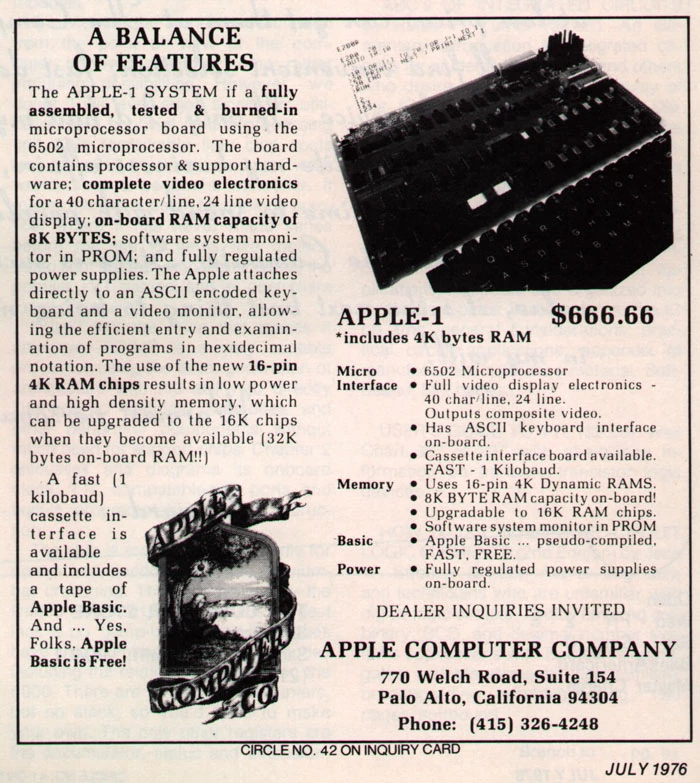
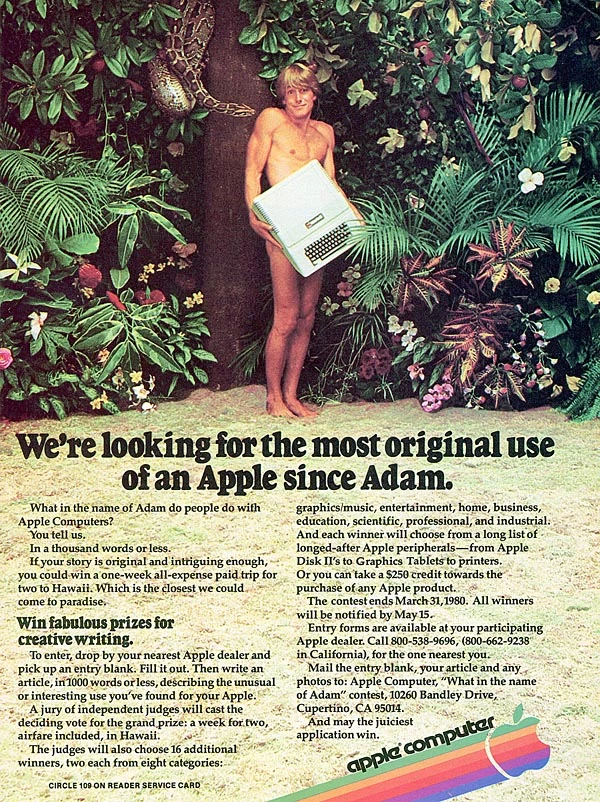
Once you realized Steve Jobs was a psyops puppet program, brilliantly manufacturerd by our friends at the intelligence agencies and their mind control and social engineering experts, "think different" takes a entirely new meaning.
-
A worm survived 46,000 years in Siberian permafrost
Researchers revived a previously unknown species of microscopic worm from ancient Siberian permafrost. after thawing, it began feeding, moving and producing offspring

-
History doesn’t repeat, but rhymes.
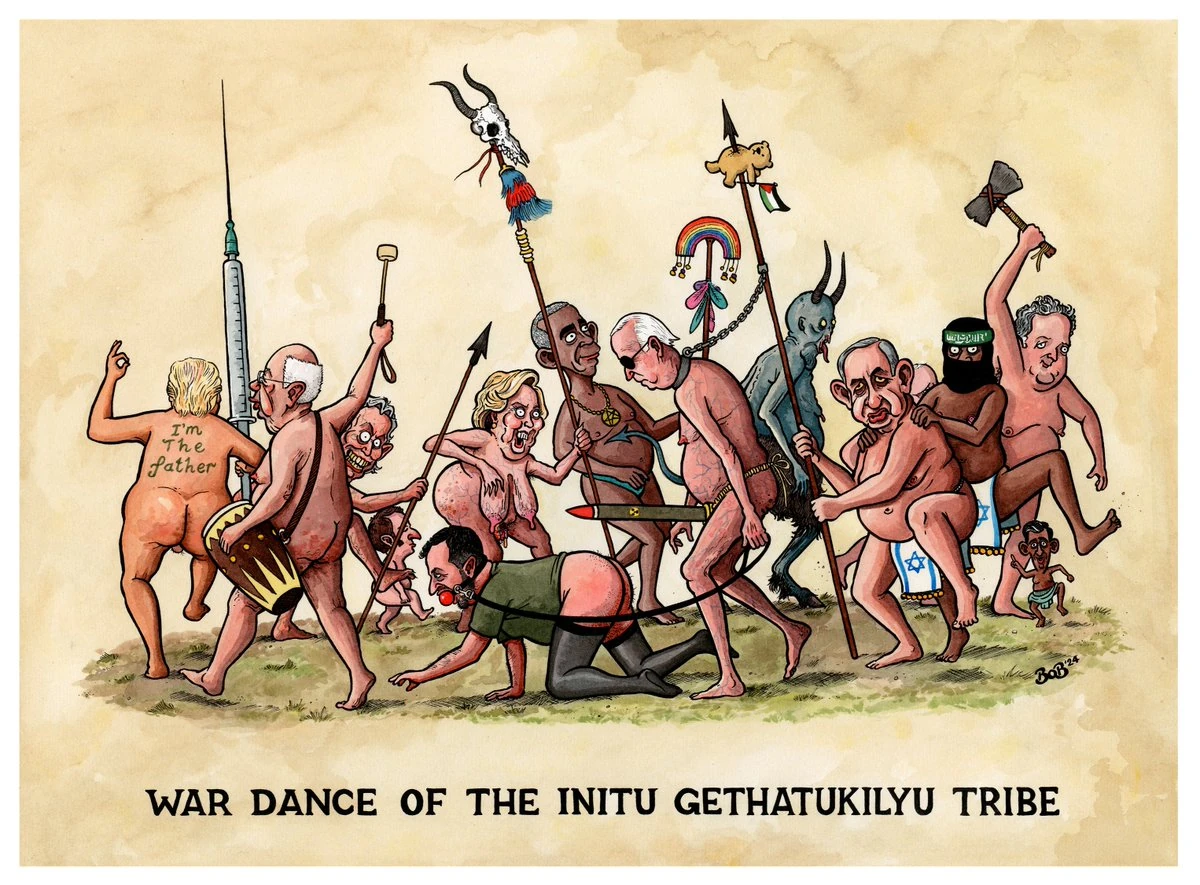
The Epstein Class War Dance Ritual In its final centuries, late Rome used the "Foederati" system - outsourcing border defense to regional "vassals" because it couldn't foot the bill alone. Arrogance stayed high, but the money ran out. The result? The very people hired to protect the gate realized they didn't need the empire, marched inward, and smashed it open. Today, the Epstein class of a strained US under intense domestic debt & internal pressure pushes vassals like Germany & Japan to rearm and handle their own security burdens.
-
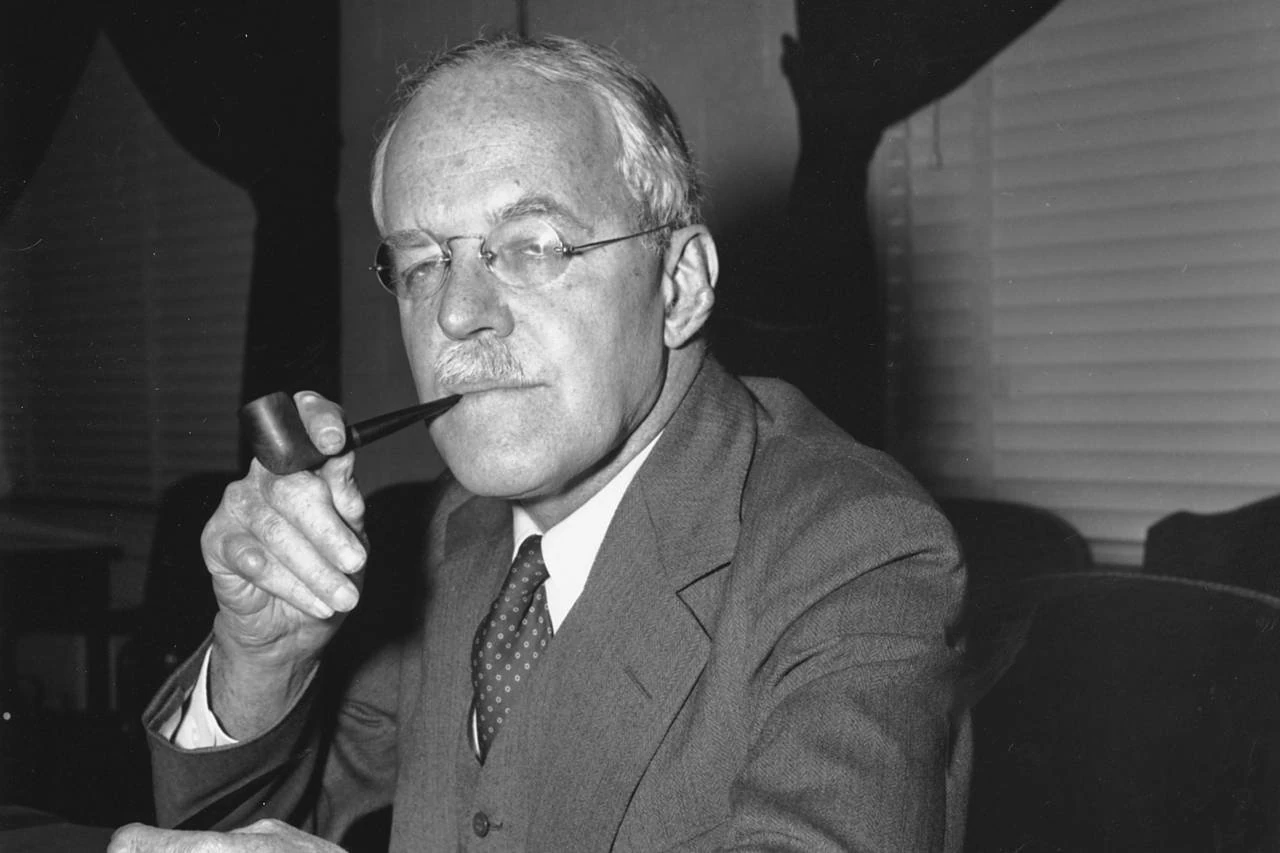
Carl Jung was an intel agency asset and secret society member?
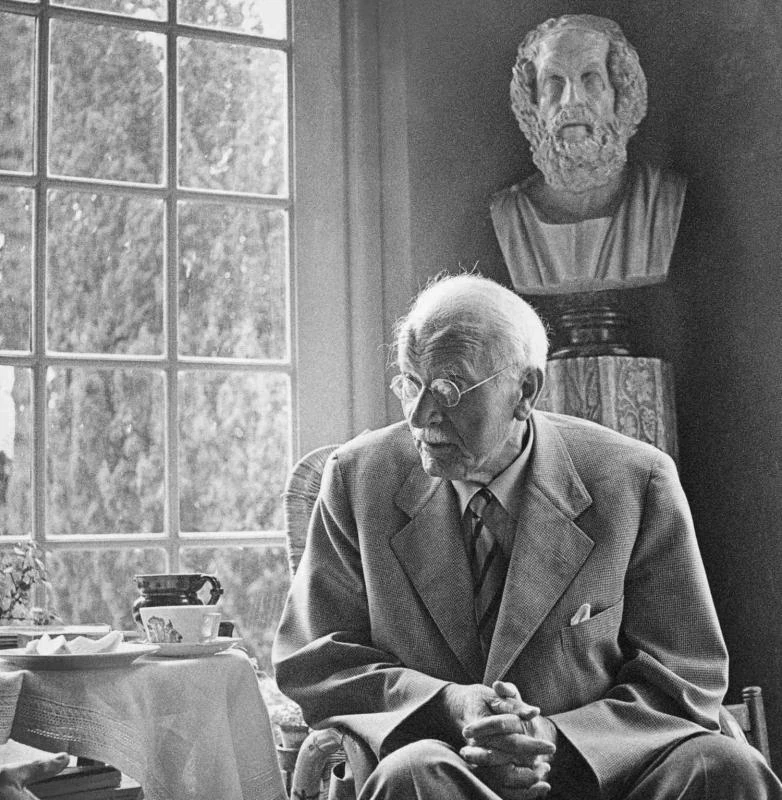
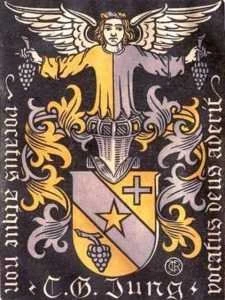
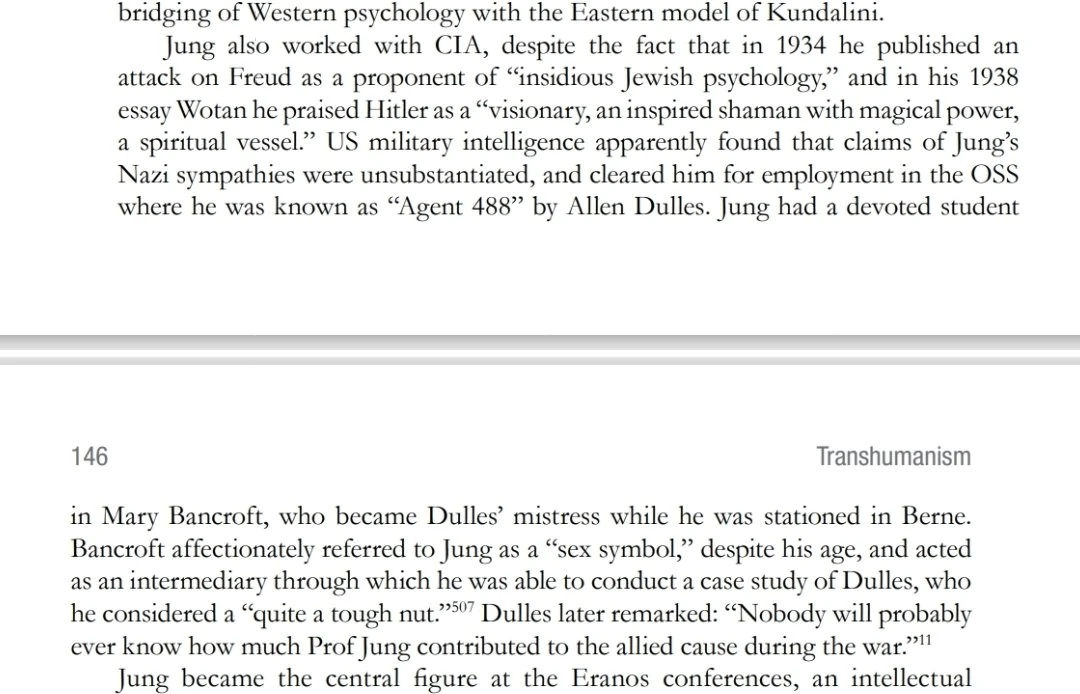
Carl Jung worked as an intelligence asset for the OSS during World War II, under which he was given the name 'agent 488' by Allen Dulles. Dulles later remarked that “Nobody will probably ever know how much Prof Jung contributed to the allied cause during the war". The uncle to Carl Jung's grandfather was a member of the Bavarian Illuminati. Jung's own grandfather was a Grand Master Freemason, and his coat of arms bore Rosicrucian and Masonic symbolism.